operations
After-hours emergency calls without missed escalations
A page sent is not an escalation. Build a written emergency taxonomy, closed-loop confirmation, and a recovery path for when nobody answers at 2 AM.
After hours emergency call handling is not simply answering the phone when the office is closed. It is a controlled process for deciding what is dangerous now, what can be booked, and what should wait until business hours. The difference matters at 2 AM, when a caller may be facing active flooding, a gas odor, a health crisis, or a problem that feels urgent but can safely wait.
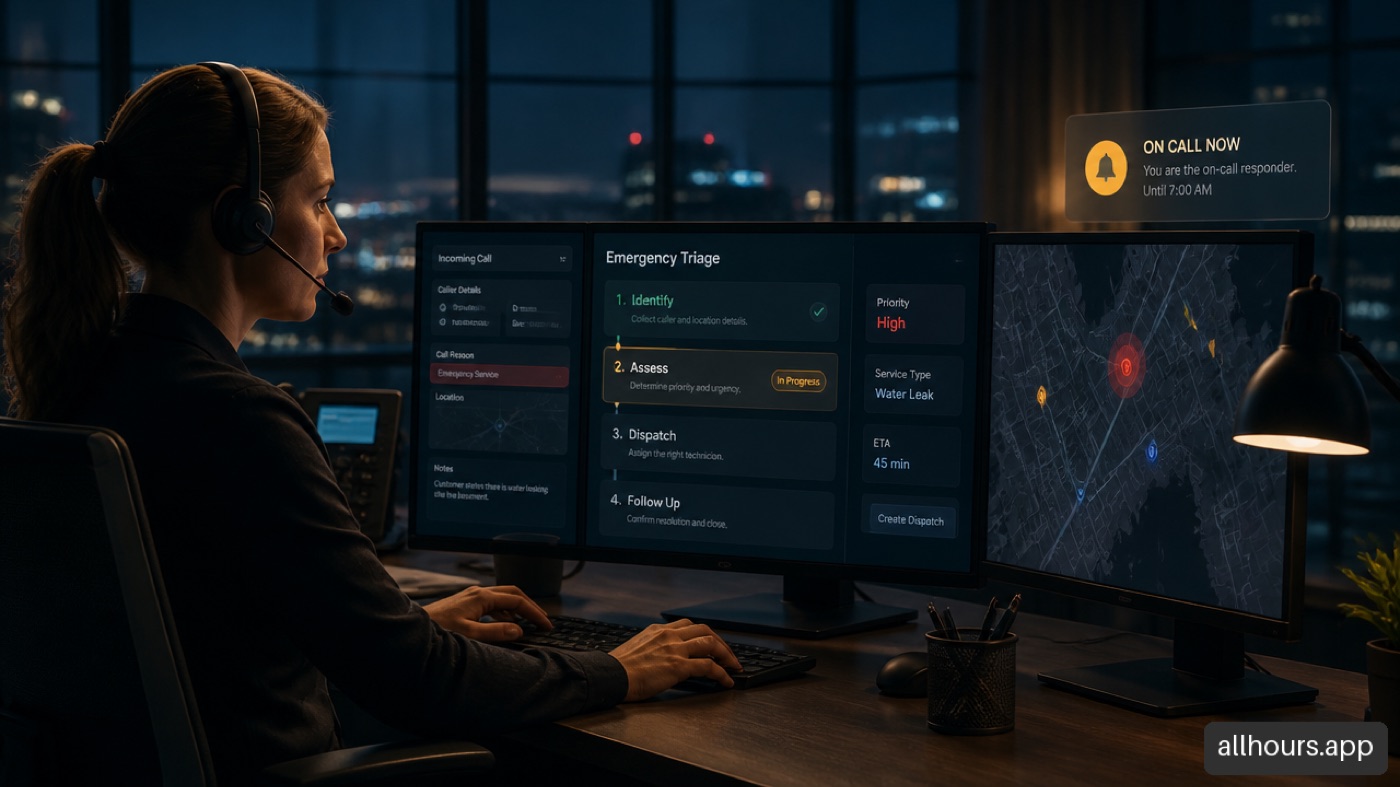
A reliable system protects callers, preserves on call capacity, and gives staff a complete record instead of a vague message. I recommend designing it around one principle: the call is not complete when an alert is sent. It is complete when the caller has safe next steps and the right person has confirmed ownership.
Table Of Contents
• Set A Written Emergency Taxonomy
• Build A Routing And Escalation Workflow
• Recover When A Transfer Fails At 2-am
• Sources
Set A Written Emergency Taxonomy
Use Three Lanes Instead Of One “Urgent” Bucket
The practical answer is to classify every after hours call into one of three lanes:
| Lane | Meaning | Expected Outcome |
|---|---|---|
| Emergency | There is an immediate safety risk, active property damage, or a time sensitive clinical concern | Give safety instructions, escalate, and confirm an owner |
| Bookable urgent work | The problem needs prompt attention but is stable enough to wait for the next available appointment | Offer an available slot and document the issue |
| Message and follow up | The request is routine, informational, or outside scope | Log the request and set a business hours callback expectation |
This prevents an expensive and exhausting mistake: treating every anxious caller as an emergency. It also prevents the opposite mistake, which is leaving a true hazard in voicemail because the caller did not use the word “emergency.”
URBLD’s three lane model for emergency, bookable, and message calls supports separating these outcomes and putting emergency criteria in writing. A written taxonomy gives the person or system answering the phone a shared rule set. It should not require someone to make a fresh judgment under pressure.
Define Hazards, Examples, And Exclusions
Your taxonomy should state both what does qualify and what does not qualify. Vague language such as “serious problem” invites inconsistent handling.
For trade services, a hazard call might be active flooding through a ceiling, a suspected gas leak, sewage backing into occupied living space, or a complete loss of power affecting medical equipment. JobWright’s trade emergency guidance identifies these as examples that may warrant after hours escalation.
A strong definition also includes exclusions. A dripping faucet with a bucket in place may need a morning appointment. No hot water can be deeply inconvenient, but whether it is an overnight dispatch depends on factors such as freezing conditions, a vulnerable resident, and the business’s stated coverage. The point is not to minimize the caller’s problem. It is to apply the same safety standard every time.
I would document each category with four fields:
- Trigger: What observable condition starts the emergency path?
- Immediate caller action: What can the caller safely do before help arrives?
- Escalation owner: Who receives the first alert?
- Exclusion rule: When should the call move to booking or morning follow up instead?
For example, an active water leak might trigger a request to shut off the nearest safe water valve, move away from electrical hazards, and confirm whether water is spreading. The operator should never coach a caller through risky repairs. When safety is uncertain, the safe instruction is to leave the area and contact emergency services or the relevant utility provider.
Separate Safety Instructions From Service Dispatch
A field technician is not a substitute for emergency responders. If a caller reports fire, immediate danger, a medical emergency, or another life threatening condition, the first instruction should be to contact 911. In healthcare, that boundary must be especially explicit. Sequence Health’s after hours patient call guidance says greetings should direct callers with life threatening emergencies to hang up and call 911, including for symptoms such as chest pain, stroke signs, and severe breathing difficulty.
That instruction should be documented, but do not let documentation delay it. The first moments of the call should focus on immediate safety. Only then should the handler collect details and activate the organization’s internal protocol.
Build A Routing And Escalation Workflow
Collect A Complete Handoff Before Attempting Transfer
A transfer is useful, but it is not a record. If the transfer fails, the call handler must be able to continue without asking the caller to repeat everything.
Before a live transfer or page, collect the minimum information needed to act:
• Caller name and a callback number read back for accuracy
• Service address, unit number, and access details such as gate codes or entry instructions
• The caller’s description in their own words
• The hazard, symptoms, or damage currently happening
• Immediate safety actions already taken
• Whether emergency services, a utility, property management, or another provider has been contacted
• The requested outcome, such as dispatch, clinician callback, or earliest appointment
• Any fee disclosure and authorization required before dispatch
A structured intake is more than administrative work. It protects against a failed callback caused by a missing apartment number, a wrong phone digit, or an on call technician arriving at a gated property with no access code.
This is where the limitations of traditional receptionists become clear. Even a skilled person can be interrupted, overwhelmed, or unavailable overnight. A defined intake sequence and integrated call record reduce dependence on memory and sticky notes.
Choose Collect And Flag Or Attempt Transfer
Not every call should be transferred. The best routing choice depends on urgency, staff availability, and the need for immediate dialogue.
| Routing Method | Choose It When | Avoid It When |
|---|---|---|
| Collect and flag | The issue is bookable, stable, or requires a callback within a stated window | A caller faces an active hazard or time critical clinical concern |
| Attempt live transfer | The on call person needs to assess details immediately or direct urgent action | The contact is unreliable and there is no documented backup path |
| Dispatch alert with callback target | The responder needs a concise case record and can call promptly | The caller needs emergency services before any business response |
For an active flooding call, use a hybrid approach. Collect the location, confirm whether electrical hazards are present, instruct the caller to take only safe steps such as shutting off water if they can do so safely, and then attempt transfer or page the on call technician. Do not promise arrival times that the business cannot support.
A service level agreement, or SLA, makes this concrete. Infonetworks describes SLA based after hours routing, where urgent calls are handled within a defined response commitment. The exact target varies by business, but written time buckets make performance measurable.
| Call Type | Suggested Initial Response Target | Escalation Rule |
|---|---|---|
| Immediate safety threat | Immediate emergency services instruction | Do not wait for business callback |
| Active property damage or critical outage | Page within 5 minutes | Activate backup if unconfirmed within 10 minutes |
| Urgent but stable service request | Callback or confirmed booking within 30 minutes | Escalate only if the promised window is at risk |
| Routine request | Logged confirmation and next business day follow up | No overnight page |
These are operating targets, not universal legal standards. A rural service area, a specialty practice, or a one person operation may need different commitments. What matters is that the greeting, script, staffing plan, and actual capacity agree with each other.
Disclose Fees Before Dispatch
After hours pricing must be part of the intake, not a surprise after the truck arrives. State the premium rate, trip charge, minimum labor charge, or diagnostic fee in plain language. Then record whether the caller approved it.
For example: “This visit has an after hours service charge of [amount] and a [minimum] labor minimum. Do you approve dispatch under those terms?” If pricing cannot be quoted accurately because the issue is unclear, explain what is known, what is not known, and what authorization is being requested.
JobWright notes that emergency work can involve minimum charges, including a two hour minimum in some trade business policies. The policy is not the problem. Unclear disclosure is. Written authorization reduces avoidable billing disputes and gives the on call team a cleaner handoff.
Recover When A Transfer Fails At 2 AM
Treat A Failed Transfer As A New Incident
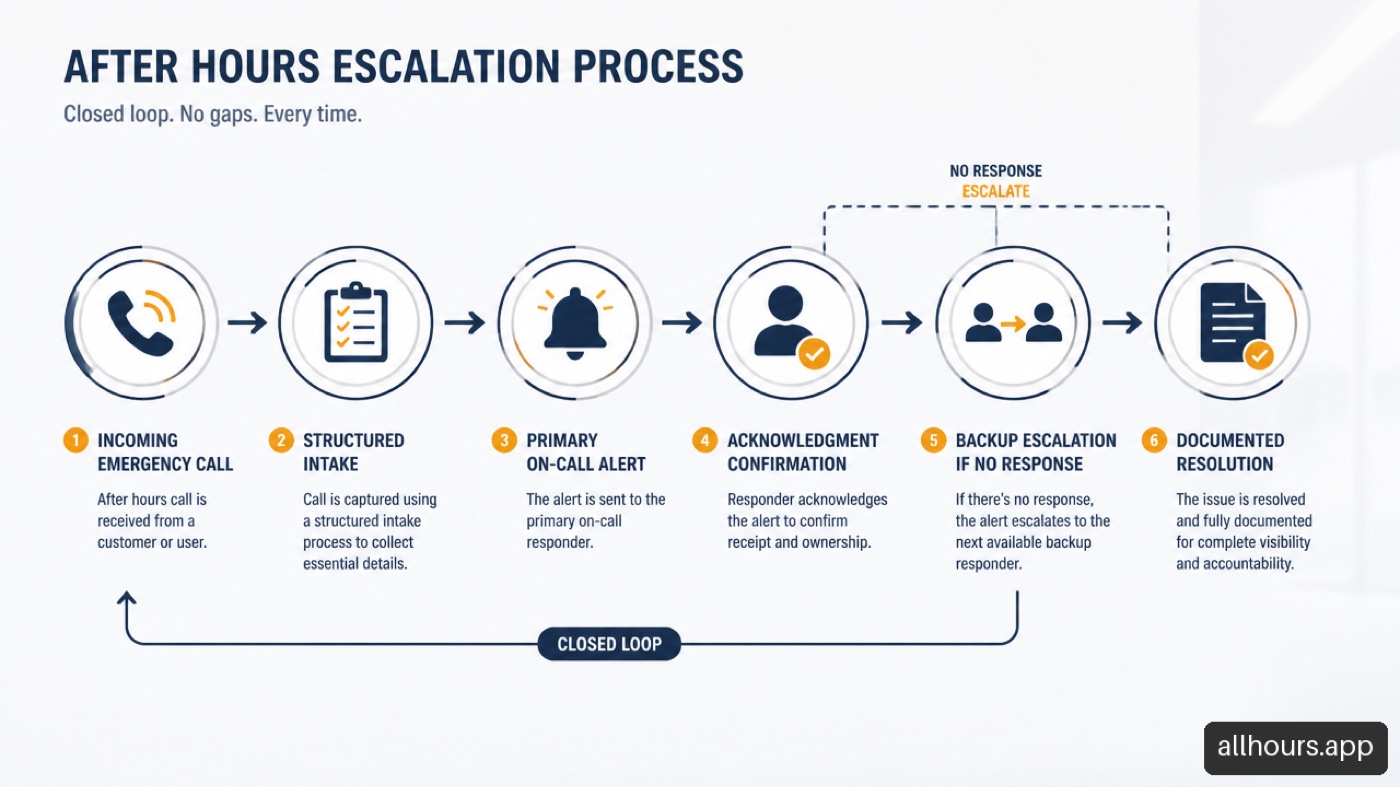
A call that rings an on call phone without an answer has not been escalated. It has entered a failure state. The system needs a timed recovery path, not hope that the first person notices later.
Use closed loop confirmation. This means the on call contact must acknowledge the alert, ideally through a reply, acceptance action, or documented call back. A sent text, voicemail, or push notification is only an attempt.
A practical escalation sequence looks like this:
- Attempt the primary transfer after collecting the full intake.
- If the transfer fails, send the case summary through the primary alert channel.
- Start a short acknowledgment timer based on the call’s severity.
- If there is no confirmation, alert the secondary on call contact.
- If the second contact does not confirm, notify the duty manager or designated escalation owner.
- Tell the caller exactly what has happened and when they should expect the next contact.
- Keep the original handler, service, or automated workflow responsible until confirmation is received.
The final step is the one many workflows miss. Ownership should not disappear between systems. If a caller with active flooding is told that a technician was notified, someone must verify that statement before ending the interaction.
Design For Common Handoff Failures
The most common failures are operational, not dramatic. A phone may be on silent. The rotation calendar may be out of date. An alert may contain no address. A technician may assume another technician accepted the job.
Use this recovery table during setup and quality review:
| Failure Mode | Prevention | Recovery Action |
|---|---|---|
| Wrong on call contact | Sync the rotation to routing rules and test before each shift | Move immediately to secondary contact |
| Alert received but not acknowledged | Require explicit acceptance | Escalate after the response timer expires |
| Incomplete notes | Make address, callback, issue, and outcome required fields | Recontact caller before dispatch if safety allows |
| Caller disconnects | Capture callback number early and read it back | Call back promptly and continue triage |
| System outage | Keep a documented manual fallback number and call tree | Use the fallback while logging the incident later |
Poor wait experiences also create drop offs. Reviewing reasons why callers hang up can help teams tighten greeting language, reduce dead air, and explain what happens next before a caller gives up.
Make The Greeting Safe And Specific
A safe greeting should identify the business, state that the office is closed, explain the available path, and provide emergency instructions without diagnosing the caller’s situation.
“You have reached [Business] after hours. For a life threatening emergency, hang up and dial 911. If you have an active service emergency, please stay on the line so we can collect details and contact the on call team. For routine service, we can help schedule the next available appointment or send your message for the next business day.”
Avoid claims such as “a technician is always available” unless that is consistently true. Avoid telling callers that a situation is safe without enough information. And avoid promising a callback time your team does not measure.
Key Takeaways
Build For Confirmed Ownership, Not Just Fast Notifications
After hours emergency call handling works when the workflow gives every caller one clear result: emergency instruction, confirmed escalation, scheduled service, or a documented follow up expectation.
• Define emergency conditions and exclusions for each trade or service line.
• Collect the full handoff before a transfer attempt, especially callback number, location, access details, and immediate hazard.
• Send life threatening situations to 911 first rather than treating them as routine dispatch calls.
• Use closed loop confirmation so a failed page triggers a real backup sequence.
• Disclose after hours fees and obtain approval before dispatch whenever the situation allows.
• Review overnight records for missed acknowledgments, delayed callbacks, incomplete intakes, and disputed charges.
The business case is not limited to emergency work. Understanding the costs of missed calls helps explain why bookable after hours requests deserve a reliable path too. A caller whose situation is not dangerous still needs a clear next step.
Frequently Asked Questions
What Counts As An After Hours Emergency Call?
An emergency call involves an immediate threat to life, safety, significant property damage, or a time critical health concern. Examples may include a suspected gas leak, active flooding, sewage entering living space, chest pain, stroke signs, or severe breathing difficulty. Each business should publish its own written criteria and exclusions.
How Should After Hours Emergency Calls Be Routed?
First provide emergency services instructions when life safety is involved. Then collect a structured intake, attempt a transfer or page the designated on call person, and require confirmation that the alert was received. If confirmation does not arrive within the defined window, escalate to a backup contact.
What Information Should Be Collected From The Caller?
Collect the caller’s name, verified callback number, service address, access details, description of the issue, immediate risks, safety actions taken, and any emergency services contact. For dispatch work, also record fee disclosure and approval.
How Fast Should Someone Respond To An After Hours Emergency?
The right target depends on risk and coverage capacity. Life threatening events require immediate 911 instruction. For active damage or critical outages, many teams set a short page and acknowledgment target, such as five minutes to alert and ten minutes to activate a backup. Stable urgent work can often be handled through a defined callback or booking window.
Should Routine Calls Go To Voicemail Or A Live Answering Service?
Either can work if the caller receives a clear next step. Voicemail is suitable for low call volume and routine requests when messages are reliably reviewed. A live service or automated intake is better when callers need booking, structured information capture, or consistent screening. Do not use either option as a reason to leave urgent calls without an escalation path.
What Happens If The On Call Person Does Not Answer?
Do not close the case after leaving a voicemail. Start an acknowledgment timer, alert the secondary contact, then escalate to the duty manager or next owner in the call tree. Keep the caller informed without making promises that have not been confirmed.
Should Healthcare And Trade Calls Be Handled Differently?
Yes. Trade triage centers on physical hazards, damage control, and dispatch feasibility. Healthcare calls may involve symptoms, patient risk, protected information, and clinician specific protocols. Keona Health describes structured clinical triage, urgent routing, and electronic handoffs, including the use of protocols designed to assess severity and urgency. Healthcare organizations should use approved clinical protocols and privacy appropriate systems rather than adapting a trade dispatch script.
Sources
• URBLD — After-Hours Call Handling for Service Businesses
• Sequence Health — How Healthcare Contact Centers Manage Patient Calls After Hours
• Keona Health — How Top Practices Handle After-Hours Calls
• JobWright — How to Handle Emergency and After-Hours Calls Without Burning Out