trust
Do customers know they're talking to an AI, and does it matter?
Some callers guess, most are unsure, and inference is not the same as being told. What disclosure actually costs, and when concealment costs more.
Sometimes. Many people infer it from a scripted reply, an instant response, or an unusually structured set of questions. But inference is not certainty. If a customer is booking a repair, reporting a burst pipe, or disputing a charge, uncertainty about who is responding turns into a trust problem fast.
A clear answer beats a clever imitation. Customers do not need an explanation of the technology. They need to know whether they are speaking with a person, an AI system, or an automated workflow — and what happens when it cannot help.

Table Of Contents
- What Customers Actually Know
- What Disclosure Costs, And When
- How To Disclose Without Making It Worse
- Test Recognition Instead Of Assuming It
- Frequently Asked Questions
- Sources
What Customers Actually Know
Three States Of Awareness
The question is not only whether customers know. It is how they know, and how certain they are.
| Perception state | What the customer thinks | Risk for the business |
|---|---|---|
| Explicit knowledge | “This is an AI assistant.” | They may question empathy or authority before seeing results |
| Inference | “This sounds automated, but I’m not sure.” | Confusion grows if the call becomes complex or emotional |
| Mistaken belief | “This is a person.” | Discovering the truth later feels deceptive, even if the AI performed well |
A caller may hear a natural voice, get a helpful answer, and assume a human. That is not proof the design succeeded. It may be evidence the identity signal was too weak.
The stakes rise with judgment. Someone saying “my elderly parent has no heat” is not only asking for an appointment. They are testing whether the responder understands urgency and has authority to act on it.
The Signals Callers Pick Up
Customers infer AI from a collection of small cues rather than one giveaway: evenly paced replies, a rigid intake sequence, difficulty with interruptions or vague requests, repeated use of their name, or a smooth answer to a routine question followed by uncertainty on an exception.
Good design reduces those signals. Removing every clue should not be the goal — there is a line between a natural experience and a setup that leaves someone feeling misled later.
“Not Human” Is Not Enough Information
A business can disclose automation without disclosing AI. “You are speaking with an automated system” says a human may not be present. It does not say whether the system understands natural language, checks availability, transfers calls, or decides anything.
| Notice type | Example wording | What it tells the customer |
|---|---|---|
| AI disclosure | “I’m the AI assistant for Bright Electric.” | The responder uses AI to converse and complete tasks |
| Automation disclosure | “This call uses an automated system.” | Some part of the process is automated |
| Human involvement disclosure | “A team member can review this request.” | A person may intervene, but not necessarily now |
That third row matters more than it looks. Research on hybrid service agents in Information Systems Research found that disclosing human involvement changes how customers communicate, and that late discovery of hidden human involvement can create feelings of betrayal. Customers may object not just to automation, but to learning afterward that a person was listening or participating without notice.
MIT Sloan Management Review argues that AI disclosures should support understandable transparency and accountability. Understandable means a customer should not have to decode branding language to know who is handling the conversation.
When “Obvious From Context” Is Not Obvious
Some disclosure rules carve out an exception when AI use is obvious from context. That sounds simple until you try to apply it. A text box labeled “Ask our AI assistant” is fairly clear. A chat bubble named “Jamie” with a profile photo is much less so. A voice that says “How can I help today?” without identifying itself is close to impossible to classify.
Use a practical test: would a reasonable first-time customer understand the responder is AI before sharing personal details, making a decision, or relying on advice? If the answer is “probably,” the context is not obvious enough.
A polished voice is not a disclosure. The more human a system sounds, the stronger the case for direct identification.
What Disclosure Costs, And When
The evidence does not support a simple rule. The effect depends on the task, the stakes, the system’s ability, and when the notice appears.
There Is A Real Short-Term Cost
Customers assign more warmth and flexibility to a human agent. When they learn otherwise, those assumptions change.
A widely discussed study published through SSRN found that early chatbot disclosure sharply reduced purchases and changed perceptions of empathy and knowledge in its study setting. An ACM study of conversational retail similarly found disclosure can reduce perceived social presence, trust, and purchase outcomes.
Anyone claiming disclosure is costless is not reading the research. But a purchase-focused interaction is not the same as scheduling a maintenance visit or reporting a problem. Customers react differently depending on whether they are being persuaded, helped, or asked to explain something stressful. Disclosure also activates what researchers call persuasion knowledge — the customer becomes alert to being influenced — which matters most for upsells and recommendations, and least for “when can someone come out.”
Failure Changes The Math Entirely
Here is the more useful decision rule. A University of Göttingen study on chatbot disclosure found that disclosure can lower trust in high-criticality services, but improves outcomes when the chatbot fails to resolve the issue.
Why? A disclosed AI gives the customer an accurate explanation for the failure. They may still be frustrated, but they are less likely to conclude that a human employee ignored obvious context or did not care. An undisclosed system that fails reads as a person being evasive or incompetent.
That is not a permission slip for bad automation. It is a reason to design recovery paths before launch.
Task Type Sets The Tolerance
| Task type | Tolerance for AI | Best design choice |
|---|---|---|
| Booking, rescheduling, status checks | Often higher | Identify the AI and complete the task quickly |
| Basic intake and FAQs | Usually moderate | Ask focused questions, offer escalation |
| Billing disputes, legal, medical | Often lower | Disclose clearly, provide human review |
| Emergencies and safety risks | Low tolerance for error | Detect urgency early, escalate on defined rules |
ScienceDaily’s summary of customer-service research reports that disclosure effects vary with issue severity — honesty helping in some failed-service cases while trust weakens in more critical ones. That mixed result makes sense. If an AI cannot solve a problem, honesty makes the limitation feel less like a broken promise. If the issue is serious, customers reasonably want a person with clear responsibility.
A roofing company can let an AI collect photos, address, and preferred times after a storm. If the caller reports a downed power line, the AI should stop asking intake questions, give the predefined safety guidance, and route the call.
Trust Is Not One Score
| Dimension | What the customer is asking | How disclosure affects it |
|---|---|---|
| Ability | Can this actually solve my problem? | Explaining capabilities raises confidence when the system performs |
| Integrity | Is this company being honest with me? | Hidden automation causes sharp credibility loss if discovered |
| Benevolence | Does this have my interests in mind? | Fast escalation matters more than human-sounding wording |
A study of trust in AI customer service chatbots identifies transparency and problem-solving ability as the key drivers. That pairing is the point: a transparent AI that cannot complete basic tasks still frustrates people, and a capable AI that hides its identity performs well until the first failure exposes the gap.
Competence matters more than voice quality. For a service business, customers judge on practical outcomes: did it understand the issue, collect the right address and details, offer an appointment that actually exists, recognize an emergency, and confirm what happens next? A warm voice that cannot book is still a dead end.
This is why the bar isn’t a perfect receptionist. The comparison is not an AI against an ideal human employee. It is a completed, accurate interaction against voicemail, a long callback delay, or no answer at all.
How To Disclose Without Making It Worse
A Short Opening, Then Get To Work
Three parts, in one sentence:
- Identity: “I’m the AI assistant for…”
- Scope: “I can schedule, answer common questions, and collect job details.”
- Escape route: “For urgent or unusual issues, I can connect you with the team.”
“Thanks for calling Northside Heating. I’m the AI scheduling assistant. I can find an appointment, take your service details, or get a team member for urgent issues.”
It is direct, does not apologize for the technology, does not claim to be a person, and gives the caller a reason to keep going. Avoid vague wording like “I’m your assistant.” Also avoid explaining natural language processing — nobody called for the architecture.
Disclosure can be lighter for low-risk touchpoints. A text reminder saying “This is an automated message from Northside Heating” is enough. A long, higher-stakes voice call should be more explicit.
Keep Identity Persistent In Long Conversations
First-interaction disclosure is necessary but sometimes insufficient. People return to chat windows, hand the phone to someone else, or continue hours later.
For text and web chat, keep a visible “AI Assistant” label in the header. For long calls, a brief reminder is appropriate before a major change in task — moving from booking to payment questions, for instance. Do not repeat “I am AI” every few messages; that becomes noise. Repeat it when context has changed enough that a reasonable person could lose track.
Make Handoffs Unmistakable
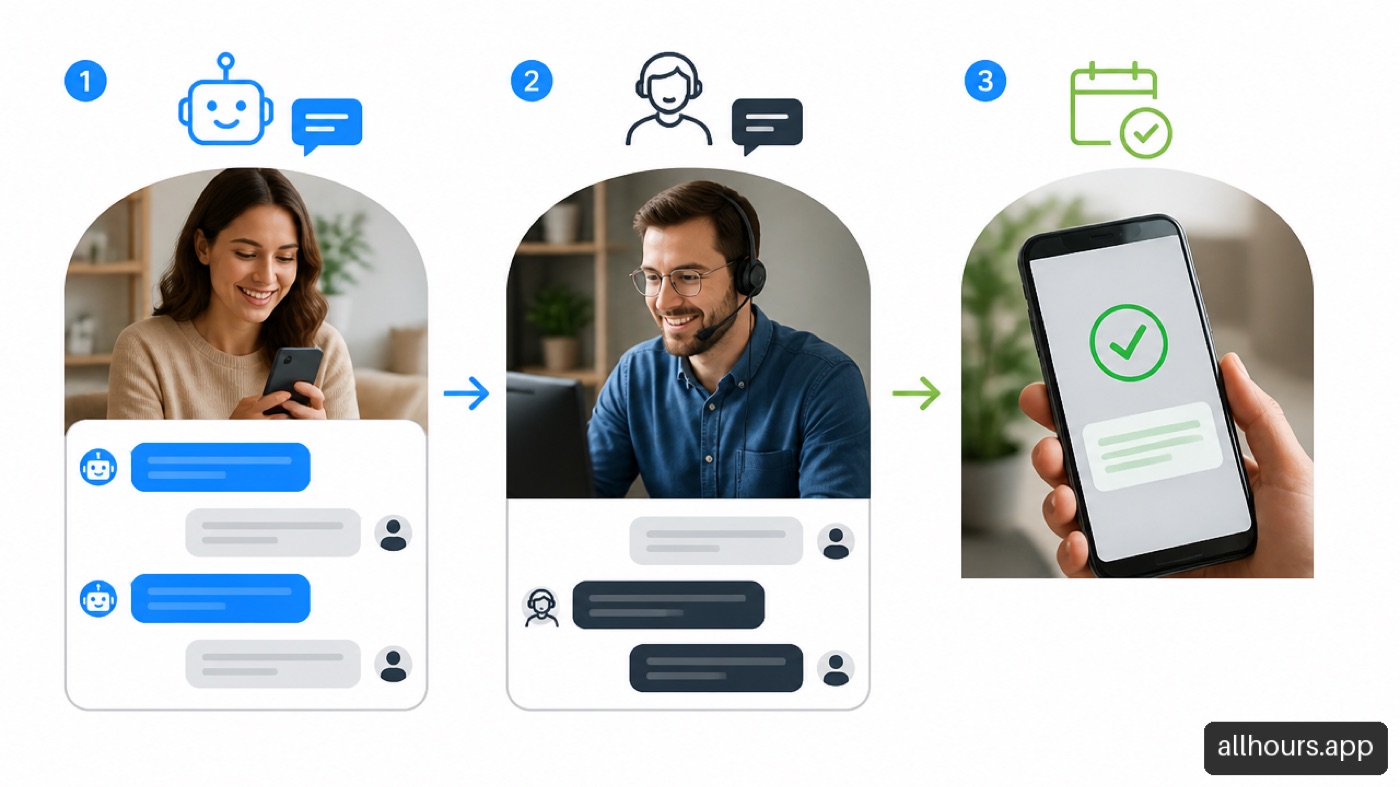
An unclear handoff creates a specific failure: the customer does not know whether a person took over, whether the AI is still responding, or whether anyone received the request.
- AI to human: “I’m transferring you to Morgan from the scheduling team now.”
- Human enters: “Hi, this is Morgan. I’ve reviewed the details you shared with the assistant.”
- Nobody available: “The office team is unavailable right now. I’ve recorded your request and will send it for follow-up by 9 a.m.”
The handoff must carry context, not force the caller to repeat everything. A structured record of the problem, location, urgency, and requested appointment makes the transition feel coordinated rather than evasive — and it addresses one of the real reasons people hang up.
Explain Delays In The Moment
Transparency is not one sentence at the start. If a booking lookup takes several seconds, say “I’m checking the next available times now.” If the request is not understood, say “I want to make sure this is handled correctly, so I’m getting a team member.” Small moments, but they stop the caller inventing an explanation like “they’re ignoring me.”
Test Recognition Instead Of Assuming It
Do not judge disclosure by whether your team thinks the wording is clear. Ask customers afterward: “Who did you think you were speaking with?” Then compare with reality.
- Show a call opening to first-time users and ask whether they believe the responder is human, AI, automated, or unclear.
- Review transcripts for moments when customers ask, “Are you a real person?”
- Track transfers, hang-ups, complaints, repeat contacts, and booking completion after disclosure changes.
- Test the same disclosure across routine and high-stakes scenarios rather than relying on one average.
If customers routinely answer “I thought it was a person,” the system is not transparently designed, even if a disclosure technically appears somewhere in the flow.
Frequently Asked Questions
Do customers know when they’re talking to AI?
Not always. They may infer it from pace, wording, or structure, but inference is weaker than clear identification. A natural voice or friendly bot name can make people assume a human unless the system says otherwise.
Should businesses tell customers?
Yes, especially for service, scheduling, sales, intake, or decisions that affect the customer. A short, plain-language disclosure protects against mistaken belief and gives customers a basis for deciding whether to continue or ask for a person.
Is “virtual assistant” clear enough?
Sometimes, but it can still be vague. Pair it with a direct statement such as “AI virtual assistant” if the goal is certainty. Customers should not have to interpret branding language to understand who is responding.
Does disclosure always reduce trust or sales?
No — the effect is conditional. It may lower purchase intent in some sales settings, while reducing frustration when a system cannot solve a support problem. Task, urgency, resolution quality, and the availability of human help all change the outcome.
When should an AI identify itself?
At the first meaningful interaction, before the customer shares sensitive information or relies on the response. For long chats or returning users, keep the label visible and repeat it when context materially changes.
Can an AI pretend to be human?
It should not. A natural voice and conversational language are fine; intentionally creating a false belief that a human is responding is not. The risk is highest when the customer later learns the truth after discussing a complaint, emergency, or payment issue.
Do customers react differently to hybrid human and AI support?
They can. Someone may be comfortable with AI collecting appointment details but want to know when a dispatcher is reviewing or joining. Explain the handoff — hidden human review feels invasive if revealed later.
What should happen if the AI cannot help?
Say so clearly, explain the next step, and preserve the information already collected. “I can’t resolve that billing issue directly, but I’ve sent your account details and request to the office team” beats a vague promise that someone will look into it.
Sources
- MIT Sloan Management Review — Artificial Intelligence Disclosures Are Key to Customer Trust: https://sloanreview.mit.edu/article/artificial-intelligence-disclosures-are-key-to-customer-trust/
- SSRN — Machines versus Humans: The Impact of AI Chatbot Disclosure on Customer Purchases: https://papers.ssrn.com/sol3/papers.cfm?abstract_id=3435635
- INFORMS / Information Systems Research — More Than a Bot? The Impact of Disclosing Human Involvement on Customer Interactions with Hybrid Service Agents: https://pubsonline.informs.org/doi/10.1287/isre.2022.0152
- University of Göttingen — Trust me, I’m a bot: repercussions of chatbot disclosure in different service settings: https://www.uni-goettingen.de/de/document/download/0a0cb34d6c10c02ed20eca822f57db4f.pdf/10-1108_JOSM-10-2020-0380.pdf
- ACM — Should a Chatbot Disclose Itself? Implications for an Online Conversational Retailer: https://dl.acm.org/doi/10.1007/978-3-030-68288-0_1
- PMC — Building user trust in AI chatbots for customer service through transparency and problem-solving ability: https://pmc.ncbi.nlm.nih.gov/articles/PMC12953761/
- ScienceDaily — Trust me, I’m a chatbot: https://www.sciencedaily.com/releases/2021/07/210714131902.htm