playbook
How to prioritize service calls without crying wolf
Urgent should not mean the caller is upset. A four-tier system that separates safety screening from scheduling, with explicit override rules.
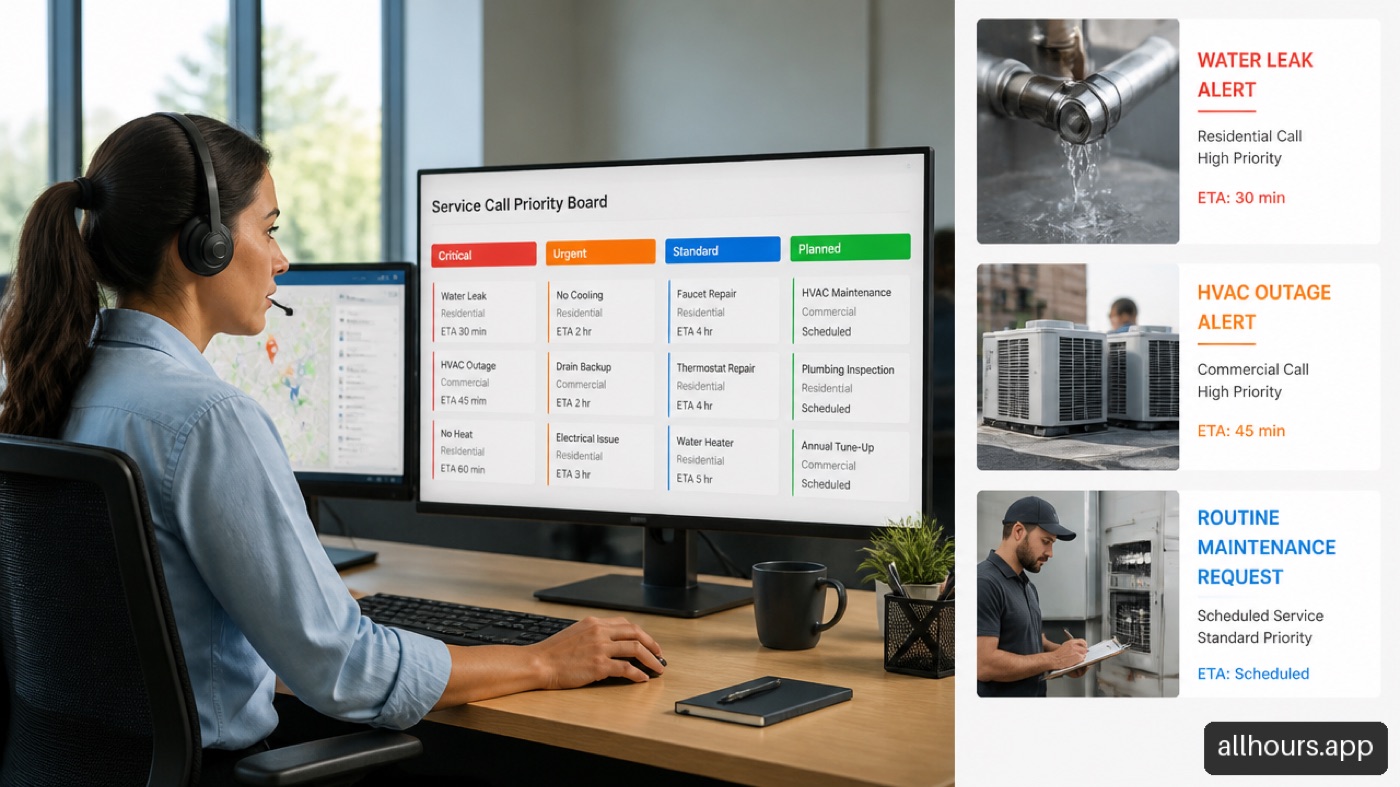
Knowing how to prioritize service calls is not about making every caller feel like an emergency. It is about getting the right response to the right problem at the right time.
A leaking gas line, a flooded medical office, and a customer asking whether a filter needs changing should not land in the same queue. When they do, dispatchers burn out, technicians get routed poorly, routine customers wait too long, and real emergencies can be missed.
I recommend a rules based process that separates safety from scheduling, protects service level agreements, and gives customers a clear expectation even when they cannot be seen immediately. The goal is simple: urgent work moves fast, routine work stays visible, and no one has to rely on memory or whoever calls the loudest.
Table Of Contents
- Build A Priority System That Overrides The Queue
- Screen For Safety Before You Schedule
- Dispatch With Skills, Parts, Routes, And SLAs In Mind
- FAQ: How To Prioritize Service Calls
- Sources
Build A Priority System That Overrides The Queue
First come, first served feels fair because it is easy to explain. It also fails when the first caller wants a tune up and the next caller has water running through a ceiling. Priority should reflect risk, impact, time sensitivity, and the ability to prevent further loss.
A written rule book matters because it makes the decision repeatable. It also gives call handlers permission to follow the process instead of improvising under pressure. FieldPie recommends assigning every call a documented priority rather than relying on gut feel. That documentation should include the reason for the priority, not just a label.
Use Four Priority Levels, But Keep Escalation Narrow
Four levels are usually enough for a service business with multiple technicians, service areas, or customer commitments. A very small team may start with only Normal and High, then add detail once the process is working.
| Priority | Typical Condition | Response Goal | Scheduling Rule |
|---|---|---|---|
| P1 Critical | Immediate safety risk, active major damage, essential service outage | Immediate escalation | Interrupt normal dispatch when qualified help is available |
| P2 Urgent | Serious operational impact, worsening issue, likely major damage if delayed | Same day when possible | Move ahead of routine work, but verify skill and parts match |
| P3 Standard | Service disruption with a workable temporary condition | Next available appointment | Schedule within the normal service window |
| P4 Planned | Maintenance, estimates, advice, non urgent follow up | Scheduled window | Batch by route, technician, or customer preference |
The labels are less important than the override rules. A P2 call should outrank an earlier P3 call only when delaying it creates a meaningful increase in safety risk, property damage, business interruption, SLA exposure, or customer harm.
A priority system fails when “urgent” means “the caller is upset.” Frustration deserves a respectful response, but it is not automatically a dispatch emergency.
Define What Can Override An Earlier Call
I recommend documenting specific conditions that can move a later call ahead of work already waiting. This prevents the queue from being reshuffled for vague reasons.
A later call can override an earlier call when it meets one or more of these tests:
• Safety test: There may be danger from gas, electricity, fire, contaminated water, structural instability, security exposure, or a medical concern.
• Damage growth test: The problem is actively worsening and delay is likely to create much higher repair costs. A small plumbing leak becomes different when water is spreading across finished flooring.
• Essential function test: A customer has lost a critical function, such as heat during dangerous cold, cooling in a care environment, power to essential equipment, or water service for a regulated business.
• SLA test: A contractual or promised response target is close to being missed.
• Recovery test: A qualified technician with the needed parts can restore service quickly, while the existing job can safely wait.
This last point is easy to overlook. Urgency alone does not fix a problem. Sending the nearest technician who lacks the right license, diagnostic skill, or replacement part can waste the only immediate response window.
ServiceTitan describes field service prioritization using contextual factors such as warranty status, membership status, equipment age, equipment condition, and location. Its guidance shows why a single ranking factor is rarely enough: field service priority criteria can combine warranty, membership, equipment condition, age, and location rather than treating every breakdown alike.
Apply A Fairness Rule For Customer Value
Membership, contract, and warranty status can matter. They may carry response promises, retention risk, or pre sold service obligations. But they should not override a real safety event for a nonmember.
Use customer value as a tie breaker within the same risk level, not as a shortcut around safety.
For example, two P3 no cooling calls arrive within an hour. One is from a maintenance member with a same day commitment, and the other is from a new customer without a defined response promise. Prioritizing the member may be reasonable. If the new customer reports a medically vulnerable occupant or a hazardous electrical smell, the call must be screened again and may move to P1 or P2.
The same principle applies to the cost of missed calls. A missed opportunity may have revenue value, but revenue potential should not distort a safety based service queue.
Screen For Safety Before You Schedule
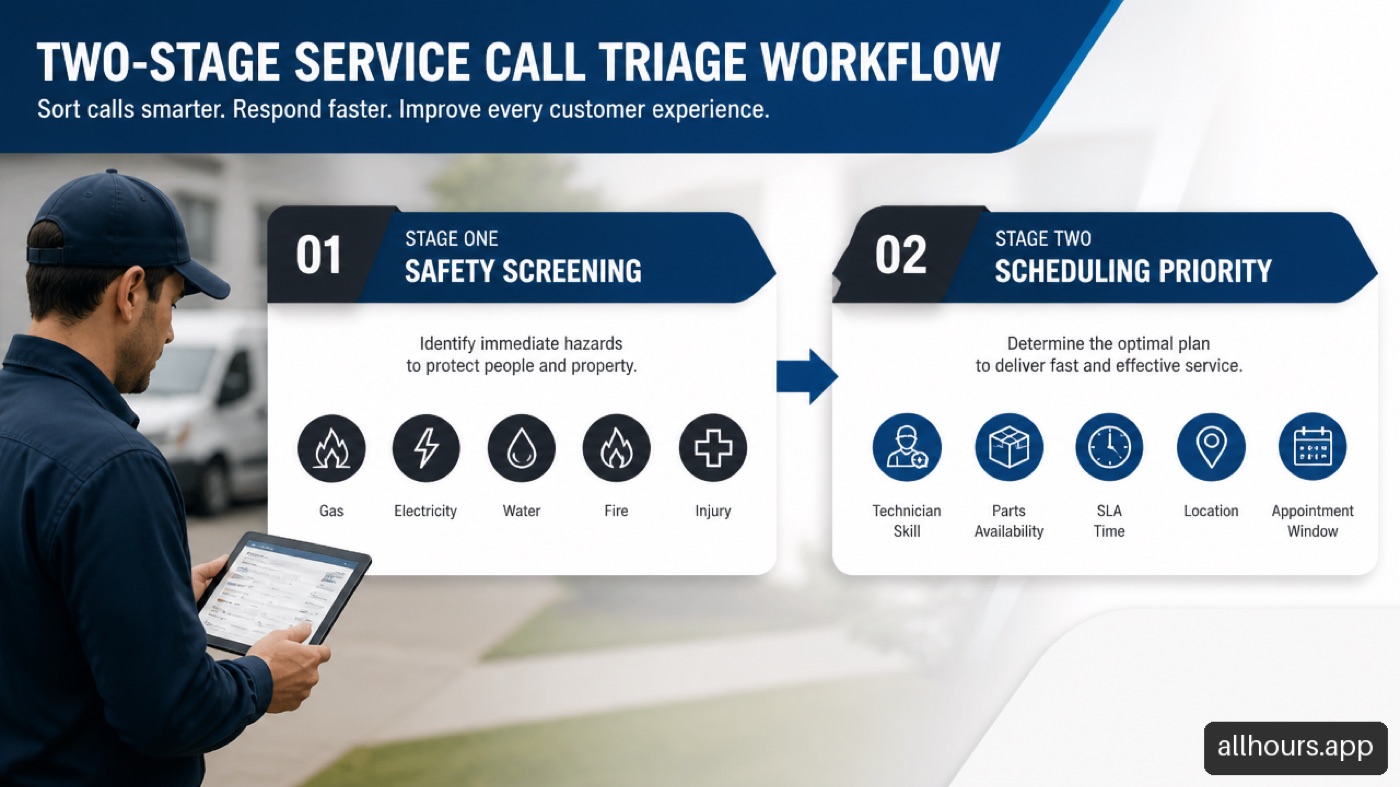
The strongest triage systems use two stages. First, identify whether the caller needs immediate safety guidance or emergency escalation. Second, assign a scheduling priority once immediate danger has been ruled out or addressed.
Combining these stages is risky. A call handler who is trying to find a time slot may fail to ask the one question that reveals an active hazard.
Stage One: Ask Safety Questions First
The first questions should be short, direct, and trade specific. Do not ask callers to diagnose the problem. Ask what they can see, hear, smell, or safely observe.
For a general service business, the opening screen can include:
- Is anyone in immediate danger or injured?
- Is there smoke, a burning smell, sparking, a gas odor, standing water near electricity, sewage exposure, or structural damage?
- Is the issue actively getting worse right now?
- Has essential equipment fully stopped working?
- Can the customer safely shut off, isolate, or leave the area using instructions already approved by the business?
If the answer suggests immediate danger, the caller should be directed to appropriate emergency services where necessary, and the internal on call path should activate. A dispatcher should not treat a dangerous condition as a normal appointment request just because a technician is available later.
For trade specific intake, ask precise follow ups. A plumber may need to know whether water can be shut off. An HVAC company may ask whether there is a burning odor, a carbon monoxide alert, or a vulnerable person in extreme temperatures. An electrician may ask about sparking, heat at the panel, or loss of power affecting critical equipment.
FieldPie’s emergency triage guidance emphasizes collecting what broke, when it broke, and whether it is getting worse before assigning a documented priority. Use those questions as the minimum factual record, not as a full script: the recommended triage questions identify the failure, timing, and whether conditions are worsening.
Stage Two: Collect Scheduling Facts
Once the call is safe to schedule, capture the facts that determine who should go and when. Incomplete intake creates false urgency because dispatchers cannot tell the difference between a simple adjustment and a full system outage.
Record at least:
• Customer location and service area
• Asset, equipment, or service type
• What is working and what is not
• When the issue began and whether it is intermittent
• Photos, error codes, model details, or relevant access conditions when available
• Warranty, membership, contract, or prior service status
• Site restrictions, tenant access, pets, gate codes, and parking limits
• Preferred contact method and permission to text updates
Keep this information in one operating record. A note in a dispatcher’s memory, a technician text thread, and a separate inbox do not form a reliable system. The technician needs the same context that informed the priority decision.
Stop Repeat Calls From Distorting The Queue
Repeat contacts need a policy. Otherwise, five calls about the same non urgent issue may look like five separate urgent jobs.
When the same customer calls again, first check whether anything materially changed. If water is now spreading, equipment has failed completely, or a promised arrival window has passed, reclassify the call. If nothing changed, attach the new contact to the existing job and send a fresh update.
For repeated no fault requests, such as a customer calling several times for a filter question after receiving the same answer, it may be reasonable to freeze the priority at P4 and route the request to a callback or self service process. Fair warning: this should never become a way to dismiss a customer who is describing a new symptom poorly. The safe recovery step is to ask the safety screen again before closing or downgrading the request.
Dispatch With Skills, Parts, Routes, And SLAs In Mind
A priority code tells you how urgently to act. It does not automatically tell you which technician should go first. Good dispatch pairs urgency with the fastest credible resolution path.
Match The Job To A Technician Who Can Finish It
Dispatching the nearest person is tempting. It can be the wrong move if that technician cannot perform the work, lacks a required certification, or does not have the likely replacement part.
For each priority call, compare:
| Dispatch Factor | Why It Matters | When It Should Win |
|---|---|---|
| Safety and severity | Prevents harm and escalating damage | Always wins over route efficiency |
| Technician skill match | Avoids failed first visits and repeat dispatches | Wins when the nearest technician cannot complete the work |
| Parts availability | Turns response into a possible repair | Wins when a slightly farther technician has the needed part |
| Travel time | Reduces the time until arrival | Wins among equally qualified options |
| Existing appointment impact | Protects customers already promised service | Matters when moving work would create another serious failure |
| SLA risk | Protects contractual response commitments | Wins when target time is close and the issue is otherwise comparable |
Consider two P2 refrigeration calls. One technician is 15 minutes away but does not carry the likely control board. Another is 35 minutes away and has both the board and the required tools. If the second technician can reasonably complete the repair in one visit, the longer drive may produce the faster resolution, not just the faster arrival.
Use Separate Lanes Instead Of One Giant Queue
A single list forces dispatchers to compare unlike work all day. Separate lanes make the tradeoffs visible.
I recommend three operational lanes:
- Emergency lane: P1 work, active safety review, and jobs requiring immediate escalation.
- SLA risk lane: Calls nearing their response target, including high priority jobs that may not be emergencies.
- Planned work lane: P3 and P4 appointments, maintenance, estimates, and follow ups.
Gorgias describes using dual priority queues to keep requests nearing an SLA breach separate from other priority work. The practical lesson is useful in service dispatch too: a dual queue can place near SLA breach requests ahead of other priority work instead of letting them disappear behind new urgent calls.
Keep buffer time in the schedule for P1 and P2 work. Without it, every emergency requires breaking a promise to someone else. The right amount varies by call volume, technician count, geography, and season. Review it after peak periods rather than guessing once and leaving it untouched.
Let Aging Escalate Work Before It Becomes A Complaint
Lower priority does not mean forgotten. Every open call should have an aging threshold that prompts review.
For example, a P4 estimate request might receive an acknowledgement immediately, a callback target within one business day, and a priority review after a defined period. The exact threshold depends on your service promise. A 72 hour example may fit some support environments, but a local repair business that advertises same day help may need a much shorter rule.
The University of Florida ITS explains priority selection through a matrix tied to the invoked SLA and its target times: an SLA linked priority matrix connects classification to response and resolution targets. For service businesses, that means the clock should influence queue order before the target is missed, not after.
Communicate The Decision Without Creating Friction
Customers are more likely to wait when they know what will happen next. Acknowledge the issue, state the appointment window or callback time, and explain the next action without exposing internal queue details.
A useful message is: “Your request is logged. We are reviewing the right technician and earliest available appointment. We will update you by 2:00 p.m. If the issue becomes unsafe or worsens, call us immediately.”
Avoid saying, “Other customers are more important.” Instead, give practical guidance and a clear next step. This matters because reasons customers hang up often include uncertainty, long waits, and no visible path to help.
Key Takeaways
• Screen for safety before discussing appointment times.
• Use documented P1 through P4 rules so a loud caller does not automatically become an urgent dispatch.
• Let safety, worsening damage, essential outages, and SLA exposure override an earlier routine call.
• Match priority work to the technician, parts, and route most likely to resolve it on the first visit.
• Keep emergency, SLA risk, and planned work in separate lanes.
• Reassess calls when conditions change or when they age beyond a defined threshold.
• Send every caller a clear acknowledgement and next step, even if the job cannot be completed immediately.
The process also needs coverage outside normal office hours. Understanding the limitations of receptionists helps clarify why intake rules, availability visibility, and escalation paths must work when the front desk is busy or unavailable.
FAQ: How To Prioritize Service Calls
How Do You Decide Which Service Call To Take First?
Take the call with the highest verified safety risk or potential for immediate harm first. If no safety issue exists, compare active damage, essential service loss, SLA deadline, technician fit, and likelihood of a first visit fix. Use first come, first served only when calls have the same priority and no meaningful operational difference.
What Makes A Service Call Urgent?
A call is urgent when delay is likely to create harm, major property damage, a serious business interruption, or a missed commitment. Examples include an active water leak, an electrical hazard, a complete equipment outage in extreme weather, or a contractual response deadline that is close to breach.
Should Emergencies Always Go Ahead Of Scheduled Jobs?
True emergencies should go ahead of scheduled jobs when a qualified response is available. But do not label every inconvenience an emergency. If a technician must be moved, notify the displaced customer quickly, offer the next realistic window, and explain what happens next.
How Do You Prioritize Calls With Limited Technicians?
Reserve qualified capacity for P1 and P2 work, then assign remaining jobs by skill, parts availability, travel time, and SLA risk. A technician who is nearby but unable to finish the repair may be a worse choice than a farther technician with the correct tools and parts.
How Do SLAs Affect Call Prioritization?
SLAs turn time into a queue rule. Each call should have a response and, where appropriate, resolution target. Move jobs into an SLA risk lane before the deadline passes. This protects promised service without incorrectly treating every near deadline request as a safety emergency.
How Do You Handle Duplicate Or Repeat Service Calls?
Link repeat contacts to the original job, then ask whether the condition has changed. Escalate if the issue is worsening, the promised response window was missed, or new safety facts appear. If nothing changed, send an updated status rather than creating another competing ticket.
Should High Value Customers Get Priority?
Customer value can break ties between calls with similar urgency. It should not outrank immediate safety risks or active major damage for another customer. Put membership and contract commitments into your rule book so staff apply them consistently.
How Often Should Priority Rules Be Reviewed?
Review them after seasonal peaks, serious escalations, repeated SLA misses, or a pattern of technician rework. At minimum, look at first response time, resolution time, reassignment rates, overdue planned work, and customer complaints on a regular schedule. If P1 volume keeps rising, the issue may be poor intake rules rather than a sudden rise in emergencies.
Sources
• ServiceTitan — Call Prioritization: Chapter 9. Call Center + Field Practices: https://www.servicetitan.com/guides/contractor-playbook/call-prioritization
• Gorgias — 9 Best Practices for Prioritizing Customer Service Requests: https://www.gorgias.com/blog/how-to-prioritize-customer-service-requests
• University of Florida ITS — Prioritizing Service Requests & Incidents Overview: https://it.ufl.edu/itsm/media/itufledu/itsm/prioritizing_in_myit.pdf
• FieldPie — Emergency Service Call Triage: How to Prioritize Calls: https://www.fieldpie.com/blog/emergency-service-call-triage/