operations
Intake questions that protect profitable jobs
Every intake question should change what happens next: who is sent, when, and with what. Anything else is politeness that costs you a wasted truck roll.
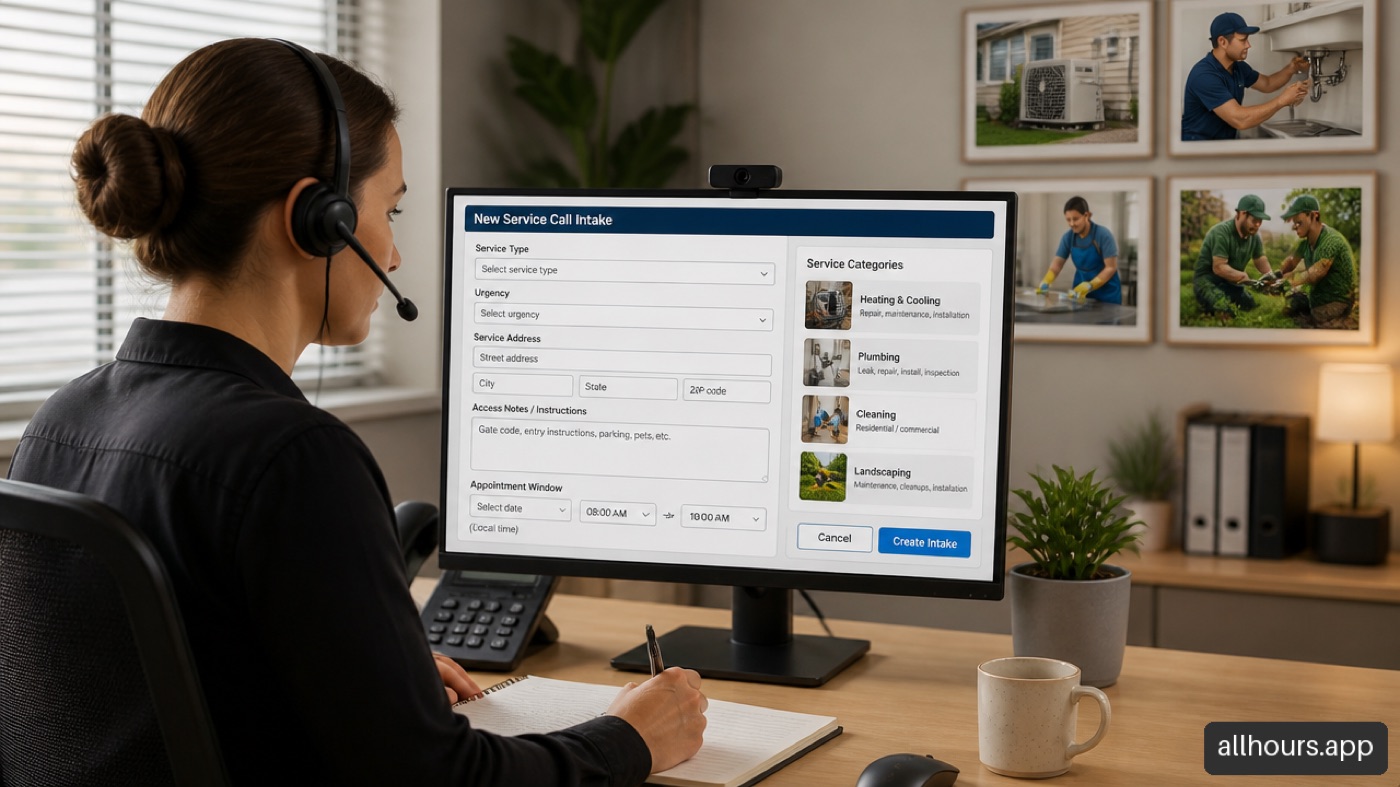
Service call intake questions are not just a script for collecting a name and phone number. They determine whether a request becomes a profitable booked job, an accurate quote, a safe escalation, or an expensive dispatch mistake.
A vague message such as “customer has a plumbing issue” forces the next person to call back, diagnose from scratch, and possibly send the wrong technician. A structured intake can identify an active leak, confirm whether the water can be shut off, capture the address and access limits, and route the request correctly the first time.
Table Of Contents
- Why Intake Questions Should Drive the Next Action
- Build a Minimum Viable Intake Set
- Use Risk Tiers Before You Book or Dispatch
- Tailor Questions by Trade and Job Economics
- Key Takeaways
- Frequently Asked Questions
Why Intake Questions Should Drive The Next Action
The best service call intake questions answer one practical question: What should happen next? That next action may be booking a routine appointment, preparing a quote, assigning a qualified technician, requesting a photo, or escalating a safety concern.
That distinction matters because intake often becomes overloaded with information that is useful eventually but unnecessary at the moment of booking. A caller does not need to complete a full customer profile before someone can determine whether their AC has stopped cooling during extreme heat or whether they need a routine maintenance visit next week.
Dexcomm’s guidance for home service intake recommends collecting critical customer, service, symptom, and access details while keeping the process limited to a small set of essential questions. Its recommendation of roughly 7 to 10 critical questions is useful as a ceiling for a live call, not a rigid rule for every situation.
A five question intake may be enough for a repeat customer booking a standard cleaning. A burst pipe, electrical hazard, or commercial move out may require more detail because the cost of missing a fact is higher than the cost of asking another question.
Separate Required Fields From Helpful Details
A reliable intake process separates information into two buckets.
| Question Type | Purpose | Examples | What Happens If It Is Missing? |
|---|---|---|---|
| Must know before action | Determines triage, price path, schedule, technician, or safety response | Service type, issue severity, address, availability, access barriers | Wrong routing, failed visit, delayed response, unsafe dispatch |
| Helpful after booking | Improves preparation or customer records without changing the immediate action | Preferred communication style, referral source, long service history | Less context, but the job can still be booked |
| Nice to have | Useful for reporting or marketing rather than service delivery | Detailed demographic data, broad satisfaction questions | No immediate operational impact |
The practical editing rule is simple: remove or defer any question that does not change the next action. If the answer will not affect who is sent, when they are sent, what they bring, what the customer is told, or whether the job is accepted, it probably does not belong in the first intake stage.
This protects caller attention. Long, unfocused questioning is one reason customers abandon conversations. Understanding the reasons why customers hang up can help teams see why every question needs a clear operational purpose.
Structure Beats Free Text Messages
Free text messages create hidden work. “Roof leak, call customer” may sound sufficient until dispatch needs to know whether the leak is active, whether the property is occupied, whether there is interior water damage, and whether access requires a ladder, gate code, or tenant coordination.
Structured questions turn those details into fields that can be filtered, scheduled, and passed into a work order. They also make intake more consistent when calls are answered by different office staff, an overflow team, or an automated receptionist.
A useful structure combines closed and open questions:
• Closed questions collect routing facts quickly: “Is water actively leaking now?”
• Open questions capture the caller’s description: “What changed before the system stopped working?”
• Probing questions clarify uncertainty: “When you say the unit is making noise, is it grinding, rattling, or clicking?”
Housecall Pro’s customer intake guide notes that intake forms can use single choice, multiple choice, and free text responses. That is useful because not every answer should be a paragraph. A leak status should be a fast choice. An unusual symptom may need the caller’s own words.
Build A Minimum Viable Intake Set
A minimum viable intake set is the smallest group of questions that lets a business make a safe, accurate next decision. It should be organized by decision purpose rather than copied from an old departmental form.
For most service businesses, the sequence below works because it starts with the caller’s goal and ends with the information needed to carry out the decision.
Ask In A Logical Order
-
Identify the requested outcome. Ask what the caller needs: repair, estimate, maintenance, inspection, treatment, cleaning, consultation, or emergency help.
-
Clarify the current situation. Ask what is happening, when it started, what changed, and what the caller has already tried.
-
Check urgency and risk. Ask whether there is active damage, a complete outage, a safety concern, vulnerable occupants, a deadline, or a same day need.
-
Confirm location and constraints. Capture the service address, property type, parking, gate access, pets, tenant rules, equipment location, and any restricted work hours.
-
Choose the service path. Book, quote, request photos, transfer to a supervisor, or dispatch an emergency resource.
-
Collect contact and confirmation details. Confirm the best callback number, email if needed, and permission to send appointment updates.
QuizFlow Labs’ intake sequence similarly recommends moving from goal to situation, constraints, files, and contact details. The order lowers friction because people can explain why they called before being asked for administrative details.
Treat Access As A Scheduling Requirement
Access questions are often treated as a footnote. They should be a core part of intake because they affect whether a scheduled job can actually happen.
Consider a cleaning crew booked for a three hour window at a secured condo building. If the intake missed elevator reservations, parking restrictions, and a pet that must be contained, the crew may lose part of the appointment waiting outside. The job becomes less profitable even if the team eventually enters.
Ask about access when the answer can change the appointment window, crew size, route, equipment, or technician preparation:
• Is the property occupied, vacant, tenant occupied, or under construction?
• Is there a gate, front desk, lockbox, key pickup, security check in, or elevator reservation?
• Are there pets, restricted rooms, hazardous materials, or on site rules?
• Is parking available for a service vehicle, trailer, or equipment?
• Are there time limits for noise, water shutoffs, loading, or building access?
Access information is profit protection. It prevents the avoidable “technician could not complete work” outcome that turns a full schedule into unpaid windshield time.
Know When To Request Photos Or Files
Photos and videos are useful when visual proof can replace several verbal questions or help determine the right resource. They are not always appropriate. A caller with a gas smell should be directed to the emergency process, not asked to photograph equipment.
Request an upload when it can materially improve preparation:
| Situation | Best Intake Move | Why |
|---|---|---|
| Unknown appliance, pool equipment, or part | Request a clear photo of the model label | Helps identify compatibility and preparation needs |
| Visible roof, fence, siding, or exterior damage | Request wide and close photos if safe | Helps assess scope before an estimate visit |
| Junk removal | Request photos plus item count and access details | Supports truck, labor, and restricted item decisions |
| Pest evidence | Request photos when practical | Helps distinguish likely pest type and treatment path |
| Safety threat or active emergency | Escalate immediately | More questioning can delay a needed response |
VoiceFrontDesk’s examples by trade show why photos, urgency, symptoms, access, and service specific qualifiers vary by service line. Visual evidence is a tool for reducing uncertainty, not a replacement for safety screening or a technician’s diagnosis.
Use Risk Tiers Before You Book Or Dispatch
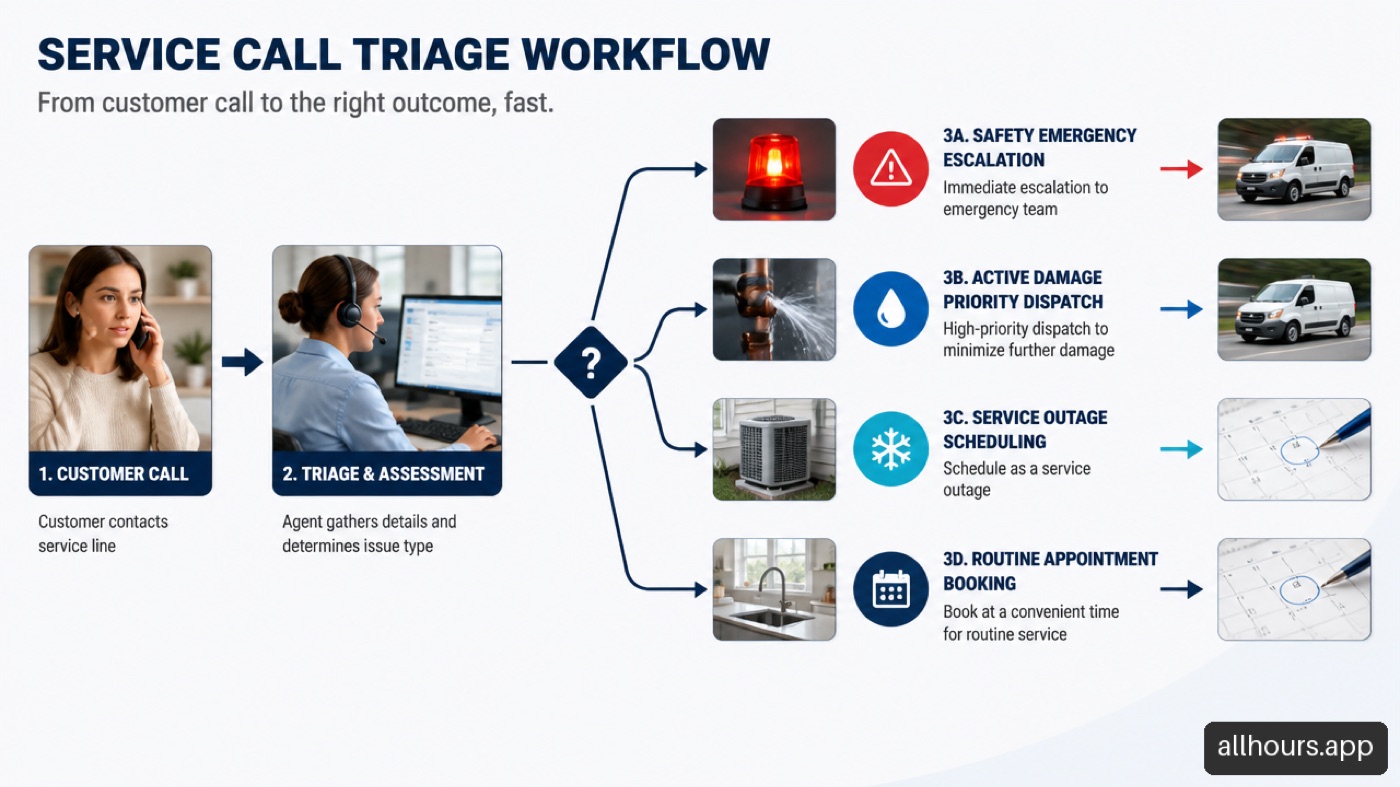
Urgency is not simply “urgent” or “not urgent.” A better intake process uses a short triage ladder with clear actions. The exact rules should reflect local regulations, insurance requirements, service capabilities, and on call coverage.
A Practical Four Tier Triage Ladder
| Risk Tier | Typical Signals | Intake Priority | Next Action |
|---|---|---|---|
| Safety emergency | Gas odor, sparking, exposed live wiring, severe injury risk, immediate danger | Confirm location and immediate safety facts only | Follow emergency protocol and escalate immediately |
| Active damage | Burst pipe, sewage backup, active roof leak, flooding | Confirm severity, shutoff status, property access | Send emergency response or offer the fastest qualified slot |
| Service outage | No heat, no cooling during extreme conditions, no power to critical equipment | Confirm system status, occupants, timing, equipment type | Prioritize based on rules and available capacity |
| Routine request | Maintenance, estimate, recurring cleaning, nonactive repair | Collect scope, location, preferences, access | Book standard appointment or estimate path |
The key is to avoid diagnosing beyond what the caller can reasonably report. Intake staff should not tell callers how to handle dangerous electrical or gas conditions unless the business has approved safety language and procedures. The role is to recognize the trigger, capture essentials, and escalate.
Escalate When The Script Stops Being Safe
Standard intake should pause when the caller reports a safety threat, unclear liability issue, aggressive behavior, a request outside the service area, or a job that requires approval beyond the person answering the call.
For example, a plumbing caller may say there is “a little water” in the basement. A probing question such as “Is water still entering the space, and can you safely shut off the main supply?” changes the response. If water is rising and the shutoff is inaccessible, this is no longer a routine repair request.
Escalation rules also protect customer trust. Automation and scripts are useful for routine work, but teams should understand the limitations of automated receptionists when a caller needs judgment, reassurance, or an exception to normal scheduling rules.
Tailor Questions By Trade And Job Economics
Every trade needs basic customer, location, timing, and access information. The difference is in the facts that protect margin, safety, and technician readiness.
A roofing company can lose money by sending an estimator without knowing whether the property is occupied or whether the concern is an active leak. A junk removal company can lose money by quoting without volume, stairs, restricted items, or parking information. A cleaning company can under staff a job if it misses occupancy, room count, pets, and service frequency.
Trade Specific Intake Matrix
| Service Type | Must Know Before Booking Or Dispatch | Details That Protect Margin | Common Escalation Trigger |
|---|---|---|---|
| HVAC | No heat or cooling status, system type, address, occupants, urgency | Thermostat behavior, equipment age, access to indoor and outdoor units | Extreme temperature exposure or medically vulnerable occupants |
| Plumbing | Active leak status, sewage backup, shutoff ability, property type | Fixture location, water damage, crawlspace access, tenant approval | Uncontrolled leak, flooding, sewage exposure |
| Cleaning | Property size, rooms, service type, timing, occupancy | Pets, supplies, heavy buildup, parking, recurring frequency | Biohazard, hazardous waste, unsafe conditions |
| Pest Control | Pest type, affected areas, severity, inspection or treatment need | Children, pets, property type, previous treatment | Stinging insects in occupied areas or severe infestation concerns |
| Pool Service | Equipment problem, water condition, route access, photos when useful | Gate code, equipment location, service history, chemical restrictions | Electrical equipment concern or significant leak |
| Landscaping | Requested work, property size, site access, deadline | Slope, gates, irrigation, debris volume, disposal needs | Downed tree, blocked access, storm damage |
| Junk Removal | Item types, estimated volume, address, access | Stairs, elevator, distance to truck, restricted items | Hazardous materials or items requiring special handling |
New Customers And Repeat Customers Need Different Paths
A new customer needs identity, service address, consent to communicate, and enough history to determine fit. A repeat customer should not be forced through the same full interview if the system already has reliable data.
For repeat customers, confirm rather than recollect:
• Is this still the correct service address?
• Is the issue with the same equipment or area as before?
• Has anything changed since the last visit?
• Are the access instructions still accurate?
• Do you need the same service, or is this a new request?
This reduces friction while catching stale records. Gate codes change. Tenants move. A previous HVAC repair does not mean today’s no cooling complaint is the same issue.
Make Intake Operational, Not Merely Polite
A friendly conversation is valuable, but the intake record must still support dispatch. Every answer should land where the next team member can use it: job type, urgency tier, work order notes, access instructions, photo attachment, scheduling restriction, or escalation flag.
That is how intake reduces the hidden costs of missed details. It also connects directly to the costs of missed calls: an unanswered or poorly captured call can mean more than a lost lead. It can mean a wasted route, a delayed emergency response, or a customer who books elsewhere after repeating the same information twice.
Key Takeaways
• Service call intake questions should drive a specific next action: book, quote, dispatch, request evidence, or escalate.
• Use a minimum viable intake set. Ask only what changes routing, staffing, timing, price path, safety handling, or site preparation.
• Separate must know details from helpful details. Contact and service facts are essential; optional background can be collected after booking.
• Treat access constraints as operational data. Gates, pets, parking, occupancy, restricted hours, and tenant rules can determine whether a job is completed profitably.
• Use risk tiers instead of a vague urgency field. Safety threats and active damage should bypass a routine scheduling flow.
• Build trade specific branches. The questions that protect an HVAC dispatch are not the same questions that protect a junk removal quote or cleaning appointment.
• Confirm existing records for repeat customers. Do not repeat the entire intake, but do verify what can change.
Frequently Asked Questions
What Are Service Call Intake Questions?
Service call intake questions are the first questions used to collect the facts needed to handle a service request correctly. They help a business identify the requested service, the customer’s situation, urgency, location, access constraints, and the correct next step.
Which Questions Should Be Asked First On A Service Call?
Start with the reason for the call and any immediate safety or damage concern. Then clarify the situation, confirm the service address, and ask the constraints that affect scheduling. Contact details can follow once the caller’s need and urgency are clear, unless an emergency protocol requires location first.
How Many Intake Questions Are Too Many?
There is no universal number because a routine booking and an emergency dispatch carry different risks. For a typical live home service call, keeping the critical intake to about 7 to 10 questions is a practical benchmark. If a question does not change the next action, defer or remove it.
What Information Is Essential Before Scheduling A Service Call?
At minimum, collect the service type, problem or requested outcome, urgency, service address, workable appointment timing, and access constraints. Add service specific details that determine technician skill, equipment, crew size, quote path, or safety handling.
What Should Be Asked For Urgent Or Emergency Service Requests?
Ask only the facts needed to identify the risk and trigger the approved response: location, immediate danger, active damage, whether the issue is ongoing, and any safe actions the customer has already taken. Do not prolong a safety related call with routine marketing or background questions.
When Should A Business Request Photos Instead Of More Questions?
Request photos when they can show equipment labels, visible damage, item volume, pest evidence, or access conditions more clearly than a verbal description. Do not request uploads when the caller reports an immediate danger, active flooding, gas odor, or another condition that needs escalation first.
How Should Repeat Customer Intake Differ From New Customer Intake?
Repeat customer intake should verify key existing data rather than rebuild it. Confirm the address, access notes, service history relevance, and what changed. New customer intake needs more identity and property context because the business has no dependable record to start from.
Sources And References
• Dexcomm — Intake and Scheduling Calls for Home Service Businesses: https://www.dexcomm.com/blog/keys-to-efficient-intake-and-scheduling-calls-for-home-service-businesses
• VoiceFrontDesk — Home-Service Call Intake Examples by Trade: https://www.voicefrontdesk.com/blog/home-service-call-intake-examples-by-trade
• Housecall Pro Help Center — Customer Intake: Request Guide: https://help.housecallpro.com/en/articles/11888575-customer-intake-request-guide
• Case IQ Knowledge Base — Hotline Intake Form Best Practices: https://help.caseiq.com/get-started/hotline-intake-form-best-practices
• QuizFlow Labs — 12 client intake questions that reduce back-and-forth: https://www.quizflowlabs.com/blog/client-intake-questions-that-reduce-back-and-forth