missed calls
How many callers hang up at voicemail, and how to measure it
Voicemail dropoff is not your missed-call rate. It is the share of callers who reach a voicemail prompt and hang up. Here is the funnel to measure.
Customer call dropoff rate when no answer and leaving a voicemail is not one number. It is a chain of outcomes: the phone rings, nobody answers, the caller may hear voicemail, may hang up, may leave a message, and may or may not respond to follow-up.
That distinction matters because a business can appear to have a reasonable callback rate while still losing most callers before they ever leave enough information to call back. For a plumbing company, dental practice, law office, or home-service business, that is not just a phone metric. It can be the difference between a booked appointment and a caller choosing the next provider in search results.
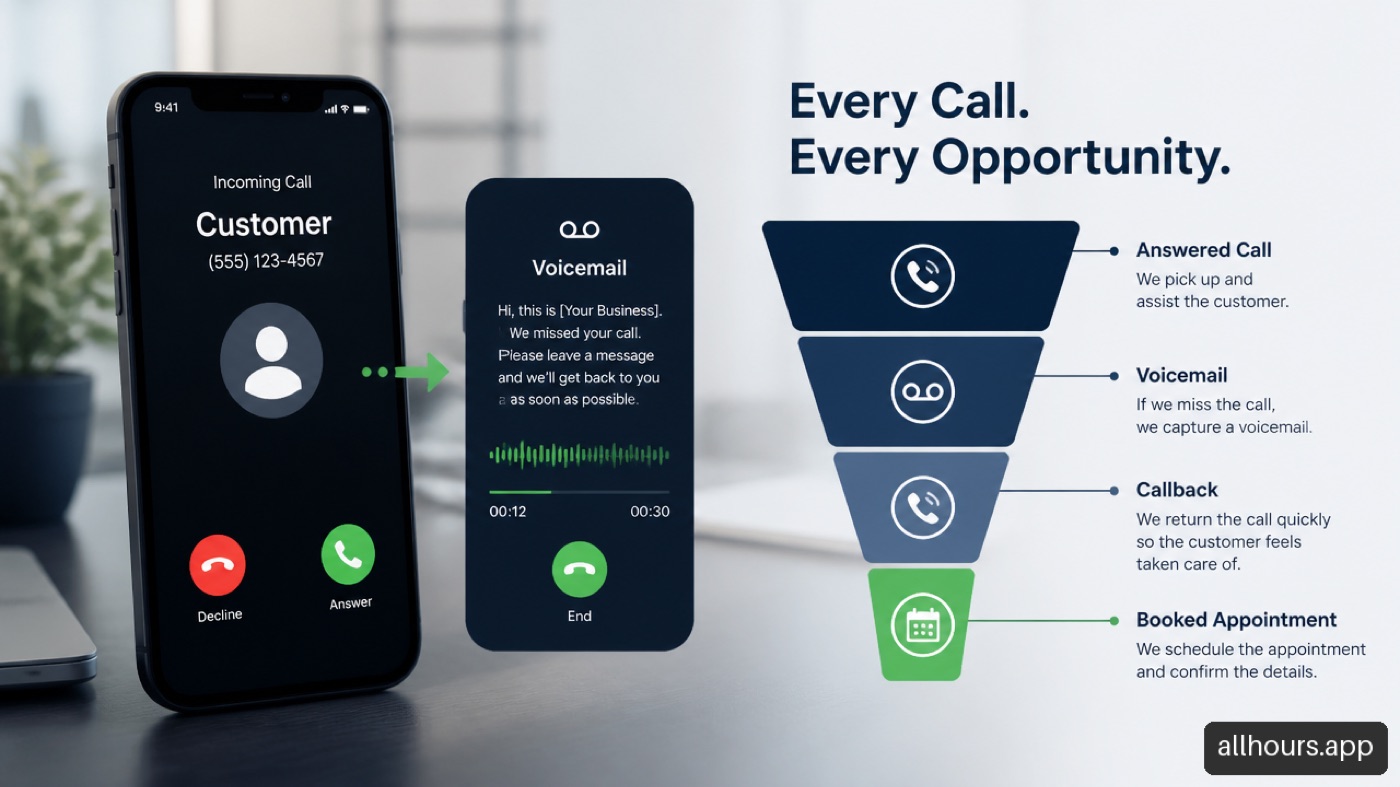
Table Of Contents
• Key Takeaways • Define And Measure The Dropoff Funnel • Compare Voicemail, Text, And Live Recovery • Build A Missed-Call Recovery Workflow • Frequently Asked Questions • Sources And References
Key Takeaways
• Voicemail dropoff is not the same as a missed-call rate. It specifically measures callers who reach a voicemail opportunity but disconnect without leaving a message.
• The most useful measurement separates each stage. Track live answers, no-answer events, voicemail exposure, voicemail left, successful contact, and booked outcome separately.
• Voicemail can preserve a small amount of engagement, but it is rarely a complete recovery strategy. Its value increases when it is paired with a rapid callback and a permission-aware text message.
• Speed changes the result. A callback placed while the customer still needs help has a very different chance of success than a callback made the next day.
• The best prevention is a live or automated answer that can complete the next step. Taking a message is better than silence, but confirming an appointment is better than taking a message.
Define And Measure The Dropoff Funnel
Use A Precise Definition
The clearest definition is this:
Voicemail dropoff rate is the percentage of callers who reach a voicemail prompt after a business does not answer, then disconnect without leaving a usable voicemail.
The phrase usable voicemail is important. A three-second recording with only a first name may technically count as a voicemail, but it may not give staff enough information to return the call. Operationally, it is closer to an incomplete lead than a recovered one.
A basic formula is:
| Metric | Formula | What It Reveals |
|---|---|---|
| Missed-call rate | Missed inbound calls ÷ total inbound calls | How often the business fails to answer live |
| Voicemail exposure rate | Calls reaching voicemail ÷ missed inbound calls | How often missed callers are offered voicemail |
| Voicemail dropoff rate | Voicemail exposures with no message ÷ voicemail exposures | How often callers abandon voicemail |
| Voicemail completion rate | Voicemails left ÷ voicemail exposures | How often callers leave a message |
| Recovery rate | Missed callers successfully contacted ÷ missed inbound calls | How well follow-up repairs missed opportunities |
| Booking recovery rate | Bookings from missed calls ÷ missed inbound calls | The commercial outcome |
For example, suppose a service business receives 1,000 inbound calls in a month. Of those, 180 are missed. One hundred twenty reach voicemail, 30 leave messages, and 90 disconnect without leaving one.
The voicemail dropoff rate is 90 ÷ 120 = 75%. The voicemail completion rate is 25%. If staff later reach 45 of the 180 missed callers through callbacks, texts, or repeat calls, the missed-call recovery rate is 25%.
Those figures tell a more useful story than saying, “We missed 18% of our calls.” The core problem may be staffing. It may be a long greeting. It may be that callers have urgent needs and no patience for a message. Each requires a different fix.
Separate “No Answer” From “Voicemail”
Phone dashboards often group several different failures into one bucket labeled “missed.” That hides the point where customers leave.
A caller can abandon in at least four places:
- Before voicemail begins. The phone rings too long, or the caller gives up after a few rings.
- During an IVR or phone tree. A menu asks the caller to press options before offering help.
- During the voicemail greeting. The greeting is too long, unclear, or sounds like no one will respond soon.
- After leaving a voicemail. The customer receives no prompt callback, loses confidence, or contacts another business.
Secondary industry summaries report a commonly cited small-business pattern in which 37.8% of inbound calls are answered live, 37.8% go to voicemail, and 24.3% receive no response. Callforce Global’s missed-call summary presents those figures as broad benchmarks, not a universal standard. That caveat matters. A busy emergency plumber and a scheduled dental office should not expect identical caller behavior.
Know What “Good” Looks Like
There is no universal standard for an acceptable voicemail dropoff rate. Intent drives behavior. Someone calling about a burst pipe may hang up within seconds and call another provider. Someone calling to reschedule a routine cleaning may be more willing to leave a message.
Use performance bands as an internal diagnostic, not as an industry promise:
| Performance Band | Voicemail Dropoff Rate | Likely Interpretation | First Response |
|---|---|---|---|
| Strong | Under 50% | Callers see some value in leaving a message | Maintain rapid callback standards |
| Watch Closely | 50% to 70% | Friction or low confidence may be reducing messages | Review ring time, greeting, and response speed |
| High Risk | Above 70% | Voicemail is losing most exposed callers | Add live backup, automated intake, or immediate SMS |
A high rate does not always mean the greeting is bad. Consider a roofing company after a hailstorm. Callers may be contacting several providers at once and accepting the first business that offers a real appointment. In that case, shortening the greeting helps, but answering or booking immediately matters much more.
The analysis should also include reasons why customers hang up, such as long holds, confusing routing, weak expectations about follow-up, and the simple fact that a caller needs an answer now.
Compare Voicemail, Text, And Live Recovery
Voicemail Is A Signal, Not A Resolution
Voicemail remains useful in 2026, but its role is narrower than many businesses assume. It gives callers a way to explain a need when no one is available. It can also make a business appear more responsive than a line that rings endlessly.
Still, voicemail asks the customer to do work: wait through a greeting, decide what details matter, speak clearly, and trust that someone will respond. That is a lot to ask from a person standing in a flooded basement or calling between meetings.
Secondary reports commonly estimate that roughly 67% to more than 80% of callers who reach voicemail hang up without leaving a message. ReadyTo.talk’s overview of missed-call statistics summarizes these ranges and highlights why voicemail abandonment should be measured separately from the total number of missed calls.
That range should be treated as directional. It is not a substitute for a business’s own call data. The right denominator is always callers who actually reached voicemail, not all inbound calls and not all missed calls.
Compare Recovery Paths Head To Head
A missed call can trigger several actions. They do not serve the same purpose.
| Recovery Method | Best Use | Strength | Main Limitation |
|---|---|---|---|
| Live answer | High-intent or urgent calls | Can qualify, reassure, and book immediately | Requires people or capable automation |
| Voicemail | Backup when live answer is unavailable | Lets customers provide context | Most callers may not leave one |
| Rapid callback | Callers who left a message or can be identified | Personal and useful for detailed needs | Value declines with delay |
| SMS follow-up | Mobile callers and simple scheduling needs | Fast, visible, and easy to answer | Requires consent and careful wording |
| Email follow-up | Known leads with nonurgent requests | Supports detailed information | Usually too slow for urgent service needs |
The available evidence on voicemail effectiveness often comes from outbound sales, so it should not be overextended to inbound service calls. Even so, Orum’s analysis of prerecorded voicemail engagement found small absolute increases in next-call pickup and callback rates when voicemail was left versus when it was not. The practical reading is modest: voicemail may improve later engagement, but it does not remove the need for fast, direct follow-up.
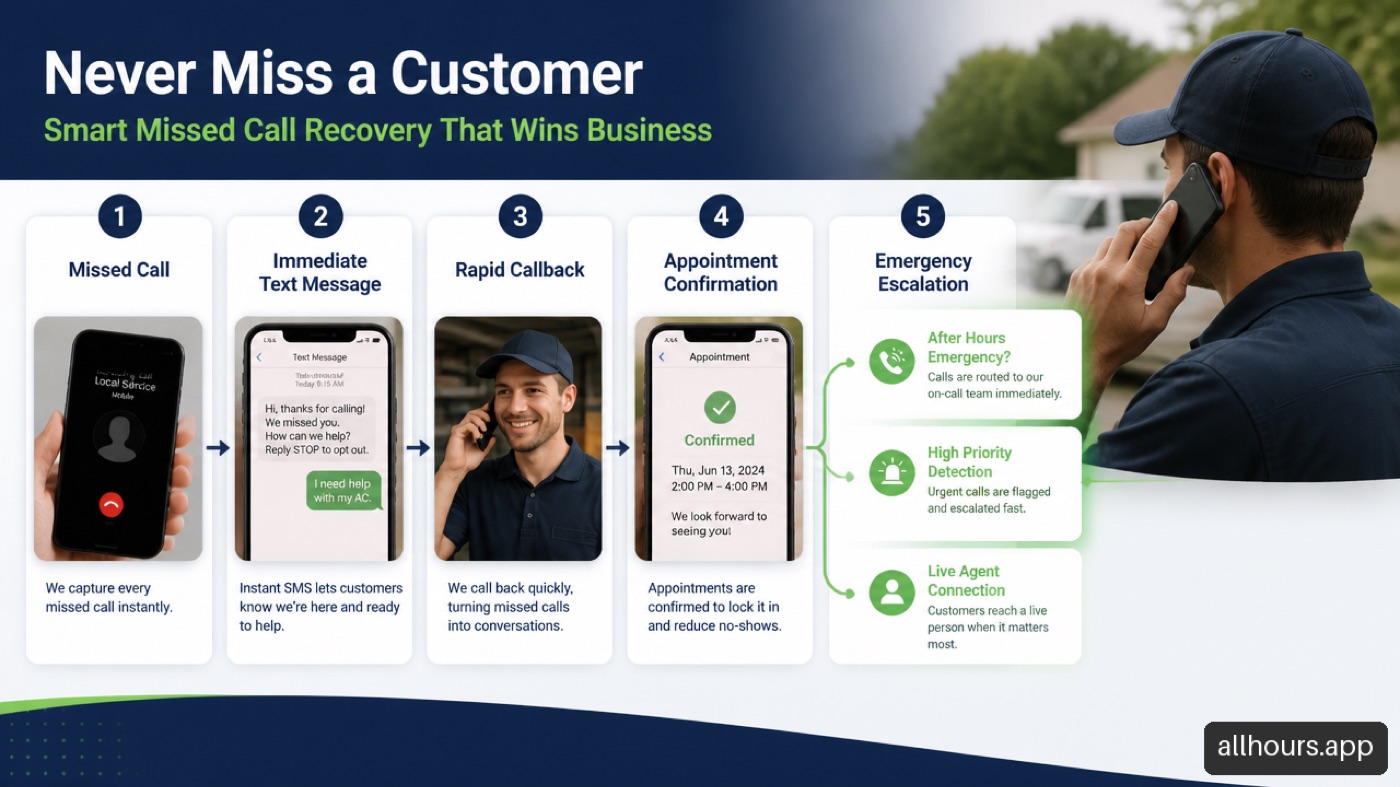
I recommend treating voicemail as a context layer. It tells the business why the person called. The recovery engine should be the next action: return the call, send an appropriate text, or offer booking through a live assistant or scheduling workflow.
When Text Is Better Than Voicemail
Text often works well after a missed call because it reduces effort. The customer can respond with a short answer, confirm a time, or state the problem without repeating a full voicemail.
A good missed-call text should be brief and specific:
“Hi, this is Northside Plumbing. Sorry we missed your call. Are you dealing with an urgent issue, or would you like the next available appointment?”
Avoid sending a vague message such as “How can we help?” It creates another round of work for the customer. Avoid text-only recovery when the call may concern an emergency, a sensitive legal matter, or a complex issue that requires a real conversation.
For high-intent service calls, use a branching rule:
- If the caller leaves an urgent message, call immediately and escalate if required.
- If the caller does not leave a message but caller ID is available, send a short text within minutes when consent and local rules permit.
- If the caller replies, continue by text only for simple scheduling or move to a call for diagnosis and urgency.
- If the caller does not reply, place one timely callback rather than repeatedly chasing a silent lead.
Build A Missed-Call Recovery Workflow
Set Response Windows Before Calls Are Missed
“Call back quickly” is too vague to manage. Define time windows, assign ownership, and track adherence.
A practical operating model looks like this:
| Time Since Missed Call | Action | Owner | Goal |
|---|---|---|---|
| 0 to 2 minutes | Automatic acknowledgement or live overflow handling | Phone system or receptionist | Confirm the caller reached the right business |
| 2 to 10 minutes | Return call or send appropriate SMS | Dispatcher or assigned team member | Reconnect while intent is still high |
| Same business hour | Second attempt for qualified leads | Assigned staff member | Recover customers who were briefly unavailable |
| Within 24 hours | Final follow-up for nonurgent inquiries | Office team or CRM workflow | Close the loop without excessive outreach |
Quo reports that many missed calls are not returned within 48 hours and that callback timing varies sharply across businesses. Quo’s 2026 small-business callback data is useful here because it frames timing as an operational issue, not simply a courtesy metric.
The first ten minutes deserve the strictest standard. A customer who just called for HVAC repair may still be looking at their phone. Two hours later, they may be driving, back at work, or already booked with another company. That is the importance of speed to lead in practical terms: response time changes whether the same customer is still reachable and still interested.
Make The Greeting Earn Its Time
A voicemail greeting should answer three questions quickly:
- Did I reach the correct business?
- What should I do right now?
- When should I expect a response?
Keep the greeting short. State the business name, offer one clear next action, and set a realistic callback expectation. If emergency service is available, say exactly how to reach it. If callers can book by text or online, offer that option without forcing them through a long menu.
Fair warning: promising “we will call right back” when the office cannot respond for hours makes the customer experience worse. A realistic expectation is more credible than an optimistic one.
Connect Phone Data To CRM Outcomes
A phone system alone can show that a call rang. A CRM or field-service platform can show whether that caller became a customer. Connect the records using phone number, call timestamp, source, outcome, and booking status.
The minimum weekly review should include:
• Total inbound calls and live answer rate
• Missed calls by hour, day, campaign, and service area
• Voicemail exposure, voicemail completion, and voicemail dropoff
• Median time to first callback
• Contact rate after a missed call
• Appointments, revenue, and emergency escalations tied to missed calls
This is where the costs associated with missed calls become visible. The calculation does not need a dramatic industry average. Use the business’s own numbers:
Estimated missed-call revenue at risk = unrecovered qualified missed calls × normal booking rate × average job value.
For example, if 80 qualified callers are not recovered in a month, the normal booking rate is 40%, and the average job value is $350, the estimated revenue at risk is $11,200. This is an estimate, not guaranteed lost revenue. Some callers were price shopping, out of area, or never ready to book. But it gives leadership a defensible way to decide whether better coverage is worth the cost.
Choose The Right Coverage Model
The right answer depends on call urgency, volume, and scheduling complexity.
| Situation | Best First Choice | When To Avoid It |
|---|---|---|
| Low call volume and routine requests | Fast human callback plus text option | Avoid if callers require immediate help |
| High after-hours call volume | Automated receptionist with structured intake | Avoid unguarded automation for serious emergencies |
| Emergency service business | Live escalation path with clear rules | Avoid voicemail-only routing |
| Appointment-based practice | Live availability and direct booking | Avoid manual booking if delays create double booking risk |
| Complex technical qualification | Structured intake followed by specialist callback | Avoid forcing customers through long phone trees |
An AI receptionist can be useful when it does more than capture a name and number. For service businesses, the stronger model is one that collects structured details, checks current availability, books an appropriate appointment, sends confirmation, and routes genuine emergencies to a human. That reduces voicemail exposure instead of trying to optimize a failing voicemail funnel.
Frequently Asked Questions
What Is Customer Call Dropoff Rate When No Answer Reaches Voicemail?
It is the percentage of callers who reach voicemail after a business does not answer and then hang up without leaving a message. Measure it using voicemail exposures as the denominator, not all calls.
What Percentage Of Callers Hang Up At Voicemail?
Published secondary estimates vary widely, commonly from about 67% to more than 80%. Use those figures only as directional context. Your own rate can differ based on urgency, greeting length, industry, and response reputation.
How Many Callers Leave A Voicemail After A Missed Call?
The answer depends on whether they reached voicemail and how urgent the request is. A useful formula is voicemail messages left divided by voicemail exposures. Track usable messages separately from incomplete recordings.
Does Leaving A Voicemail Improve Callback Rates?
It can create a small improvement in later engagement because the recipient has context and recognizes the caller. However, the available outbound evidence shows modest absolute changes, so voicemail should support rapid follow-up rather than replace it.
Is Voicemail Better Than Text Follow-Up?
Neither wins in every situation. Voicemail is better for detailed context and callers who prefer speaking. Text is often better for speed and low-effort replies. For urgent cases, a live answer or rapid callback is usually the stronger option.
How Fast Should A Business Call Back After Voicemail?
For high-intent calls, aim for minutes rather than hours. A practical target is within 2 to 10 minutes during staffed hours, with clear after-hours rules. The acceptable window is shorter for emergency services and longer for routine scheduling.
What Causes Callers To Abandon Before Leaving A Message?
Common causes include excessive ringing, long greetings, confusing IVR menus, uncertainty about when someone will respond, and an urgent need for immediate help. Review recordings and call paths to identify where callers disconnect.
Should A Business Still Use Voicemail In 2026?
Yes, as a fallback. But voicemail alone is usually not enough for businesses that depend on inbound calls for revenue. Pair it with fast callbacks, text recovery, clear emergency routing, and live or automated booking where appropriate.
Sources And References
• Orum — Does Leaving Voicemails Influence Prospect Engagement? https://www.orum.com/blog/voicemails-influence-prospect-engagement
• ReadyTo.talk — 3. Is Voicemail Still Worth… https://readyto.talk/blog/missed-call-statistics/
• Quo — Small Business Callback Statistics in 2026: Data From … https://www.quo.com/blog/small-business-callback-statistics/
• Callforce Global — Missed Call & Slow Lead Response Statistics for SMBs https://callforce.global/blog/cost-of-missed-calls-and-slow-lead-response-2026/