playbook
When customers actually call service businesses
Inbound calls cluster into three daily windows, and two of them land exactly when your office is least staffed. Here is how to cover the gap.
Understanding when do customers call service businesses is fundamental to running an efficient, profitable operation. Phone calls represent high-intent opportunities where leads convert into booked jobs, yet many operations operate on standard nine-to-five office schedules that fail to align with real customer calling patterns. By evaluating call volume distribution, emergency urgency, and customer demographics, local service providers can structure coverage, improve dispatch workflows, and capture revenue that would otherwise be lost to unanswered lines.
Table of Contents
• Key Takeaways • The Core Demand Curves: When Do Customers Call Service Businesses? • Categorizing Customer Intent: Emergency, Routine, and Outbound Cycles • Operational Friction and Missed-Call Vulnerabilities • Field-Service Capacity Framework and Call-Handling Strategies • Strategic Decision Framework by Service Sector • Frequently Asked Questions About Call Timing and Coverage • Sources / References
Key Takeaways
• Inbound customer calls follow predictable diurnal and weekly cycles, peaking early in the morning, during lunch hours, and immediately after the standard workday. • According to research on industry call patterns, service call volume peaks in weekday early evening and Saturday morning, and many businesses lack coverage during those windows. • Emergency inquiries occur at the moment of failure, whereas routine scheduling calls follow personal availability windows such as lunch breaks and early evenings. • Residential service companies experience peak inbound inquiries during off-hours, while B2B service providers see call spikes tightly linked to regular business hours. • Rapid follow-up and structured intake workflows protect customer acquisition costs and minimize lost bookings caused by unanswered calls.
The Core Demand Curves: When Do Customers Call Service Businesses?
To manage phone capacity effectively, we must first analyze the fundamental distribution of incoming call traffic. Service businesses do not experience uniform call distribution across operating hours. Instead, inbound call distribution forms distinct daily and weekly patterns driven by customer availability, household routines, and operational failures.
The Three Primary Inbound Call Windows
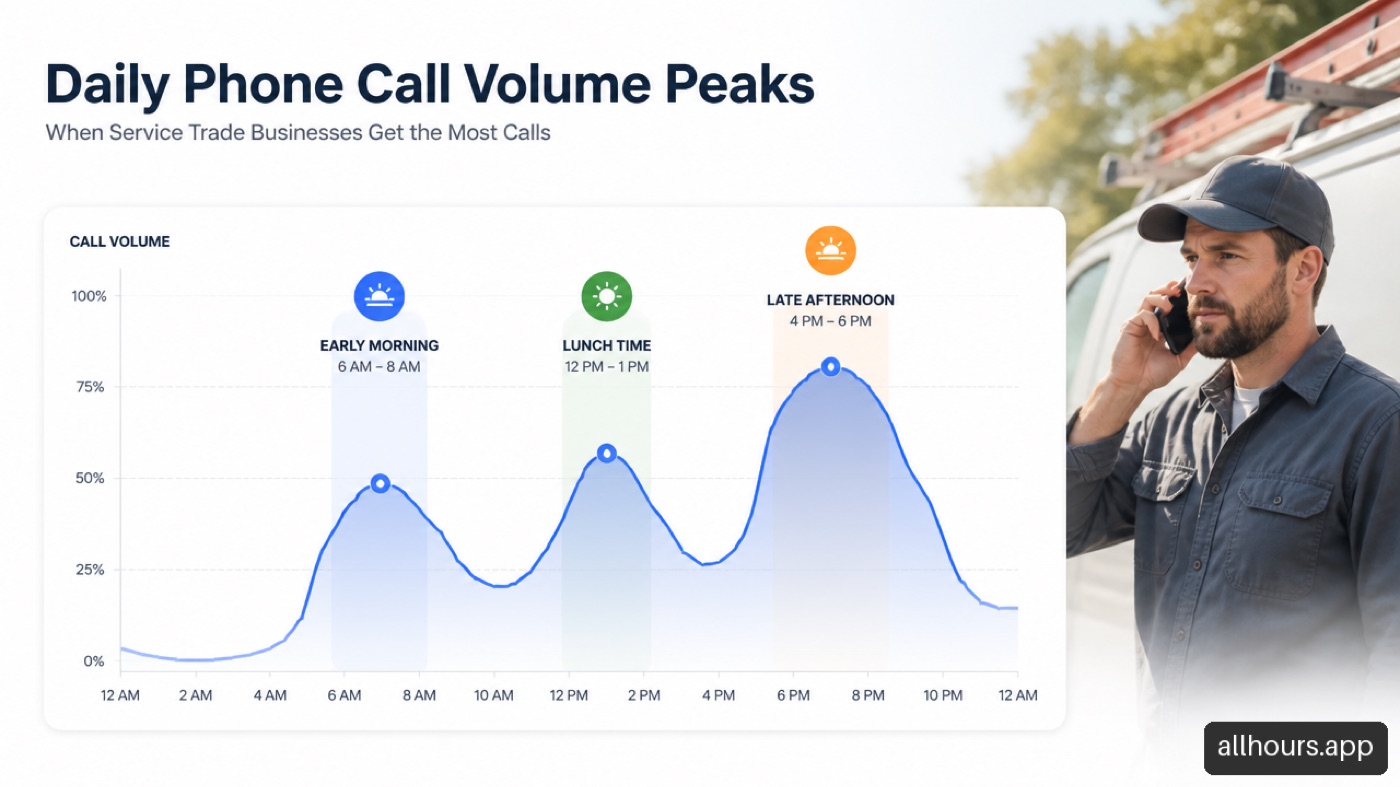
Across home services, commercial maintenance, legal practices, and healthcare clinics, inbound customer calls cluster into three core daily windows:
- The Early Morning Kickoff (7:00 AM – 9:00 AM): Customers discover overnight property damage, heating outages, or plumbing leaks as they prepare for the day. Alternatively, business managers call before their own operational day begins to arrange immediate facility support.
- The Midday Lunch Surge (11:30 AM – 1:30 PM): Working professionals utilize break periods to make personal administrative calls, schedule routine home services, or follow up on existing estimates.
- The Evening Transition (4:30 PM – 7:00 PM): Homeowners return from work, discover household maintenance issues, or finally have uninterrupted personal time to book necessary services.
Data published by customer-care-tollfree.com’s research on calling patterns indicates that customer-service call volume often rises late morning, peaks around lunch, and rises again after work. Understanding these recurring waves allows managers to organize office shift coverage around actual customer behavior rather than arbitrary business hours.
Weekday Evening and Weekend Morning Surges
While traditional office staff typically leave at 5:00 PM on Friday, consumer service inquiries continue well into the evening and weekend. The weekday evening window (5:00 PM to 7:00 PM) represents a prime scheduling period for residential customers. When families reassemble at home, minor problems—such as a noisy HVAC unit, a clogged drain, or a broken garage door—become immediate focal points.
Saturday mornings between 8:00 AM and 11:00 AM exhibit a similar concentration of inbound demand. Homeowners conducting weekend chores or managing property improvement projects use Saturday mornings to secure contractor availability for the upcoming week. Operations that rely strictly on automated answering machines or unmonitored voicemail during weekend windows routinely forfeit high-value contracts to competitors offering immediate live response or instant scheduling.
Midday Lunch Spikes vs. Staffing Asymmetry
The midday call spike presents a structural operational challenge for field-service businesses. Between 11:30 AM and 1:30 PM, call volume reaches a pronounced daily peak. Concurrently, office personnel, dispatchers, and administrative teams frequently rotate out for their own lunch breaks.
| Time Window | Inbound Call Volume Level | Office Staffing Level | Primary Call Intent Type | Operational Risk Level |
|---|---|---|---|---|
| 7:00 AM – 9:00 AM | High | Moderate | Immediate Emergency / Same-Day Booking | High (Missed early dispatches) |
| 9:00 AM – 11:30 AM | Moderate | High | Routine Inquiries / Quote Requests | Low (Adequate staff coverage) |
| 11:30 AM – 1:30 PM | Very High | Low (Lunch Rotations) | Scheduling / Status Follow-Ups | Critical (High abandon rate) |
| 1:30 PM – 4:30 PM | Moderate | High | Invoicing / Administrative Inquiries | Low (Adequate staff coverage) |
| 4:30 PM – 7:00 PM | High | Low (Shift Closeout) | After-Work Booking / Urgent Repairs | Critical (Overflow to voicemail) |
| 7:00 PM – 7:00 AM | Variable | Minimal / None | Emergency Repairs / Urgent Inquiries | High (Unanswered emergency leads) |
| Saturday Morning | High | Minimal / None | Weekend Project Booking / Maintenance | High (Competitor deflection) |
This asymmetry between incoming call volume and operational availability leads directly to long hold times, high call abandonment rates, and lost revenue opportunities.
Categorizing Customer Intent: Emergency, Routine, and Outbound Cycles
Determining when do customers call service businesses requires segmenting call traffic by caller intent. A homeowner facing a flooded basement behaves completely differently from a commercial manager requesting a quarterly janitorial bid. Recognizing these behavioral distinctions enables operations to design targeted response protocols.
Same-Day Urgency vs. Deferred Maintenance Inquiries
Inbound service calls generally divide into two core urgency profiles:
• Urgent / Emergency Calls: Driven by acute physical failures (burst pipes, electrical outages, structural leaks, AC failures in extreme heat). These calls occur unpredictably across a 24-hour cycle. Callers require immediate human or automated reassurance and real-time dispatch confirmation. If an emergency caller reaches a standard voicemail, they rarely leave a message; they immediately hang up and dial another provider. Understanding reasons customers hang up helps operators prevent lost emergency leads during high-stress moments. • Deferred / Scheduled Calls: Driven by planned upkeep, minor upgrades, or non-critical maintenance (seasonal HVAC tune-ups, tree pruning, interior painting, routine dental cleanings). These callers select timing based on personal convenience—typically late mornings, lunch hours, or early evenings. While non-urgent, these callers expect smooth scheduling and transparent availability.
Residential After-Hours Dynamics vs. B2B Workday Schedules
The operational hours of your client base dictate inbound call windows. The table below highlights the operational contrasts between Business-to-Consumer (B2C) and Business-to-Business (B2B) service delivery models.
| Operating Metric | Residential (B2C) Service Model | Commercial (B2B) Service Model |
|---|---|---|
| Peak Daily Windows | 7:00–8:30 AM, 12:00–1:00 PM, 5:00–7:00 PM | 8:30 AM–11:30 AM, 1:30 PM–4:00 PM |
| Peak Days of Week | Monday morning, Friday evening, Saturday morning | Tuesday through Thursday |
| After-Hours Call Ratio | 25% – 40% of total inbound volume | Less than 10% of total inbound volume |
| Primary Decision Maker | Homeowner / Household Member | Property Manager / Facilities Director |
| Tolerance for Voicemail | Extremely Low (Instant competitor deflection) | Moderate (Expects prompt callback within 1 hour) |
| Conversion Factor | Immediate scheduling & real-time arrival slot | Formal quote, scope approval, compliance check |
Commercial property managers work standard corporate schedules. They place inquiries during business hours when budget managers and facility staff are present. Conversely, residential clients place calls around personal responsibilities, creating substantial demand outside standard eight-to-five office schedules.
Aligning Outbound Follow-Up with Inbound Availability
Many service businesses conduct outbound calls for appointment reminders, estimate follow-ups, and unpaid invoice collections. Timing these outbound contacts correctly is essential for maintaining high contact rates.
Outbound contact success rates mirror inbound availability patterns. Calling a residential client in the middle of a Tuesday workday often yields low answer rates. Reaching out during late afternoon blocks (4:00 PM – 5:00 PM) or late morning blocks (10:00 AM – 11:30 AM) significantly improves live conversation metrics. Aligning outbound workflows with these proven contact windows maximizes administrative efficiency.
Operational Friction and Missed-Call Vulnerabilities
Knowing when customers call is only half the operational equation; the other half is maintaining sufficient capacity to process those calls. When peak inbound demand intersects with office operational limits, customer friction increases rapidly.
The Dispatch Roster Bottleneck
In field-service management, peak call periods frequently coincide with critical field dispatch activities:
- Morning Technician Rollout (7:00 AM – 8:30 AM): Office staff are busy assigning jobs, checking inventory, briefing technicians, and staging service vehicles. Inbound customer calls during this window compete directly for staff attention.
- Midday Schedule Adjustments (11:30 AM – 1:00 PM): Dispatchers manage job delays, parts run approvals, and emergency route changes. Customer inquiries arriving simultaneously overload administrative staff.
- End-of-Day Wrap-Up (4:30 PM – 5:30 PM): Staff process technician paperwork, reconcile payments, and prepare the next day’s schedule. Late afternoon customer calls often get routed straight to voicemail as staff close out daily duties.
When administrative teams are forced to choose between supporting field crews and answering phones, phone coverage suffers. Calculating the cost of missed calls highlights how much top-line revenue disappears during these daily operational bottlenecks.
Time-Zone Mismatches in Regional Operations
For regional or multi-location service providers operating across time-zone boundaries, handling incoming call timing requires careful operational coordination. A service company headquartered in the Eastern Time Zone servicing clients across Central and Mountain zones will face morning and evening coverage mismatches.
When a customer in Denver calls at 4:30 PM Mountain Time to schedule an urgent repair, the main administrative office in Charlotte (6:30 PM Eastern Time) may already be closed. According to Prospeo’s timing framework, best calling windows often occur in the customer’s local time zone, with 10–11 a.m. and 4–5 p.m. as strong blocks. Multi-regional service businesses must configure call routing around the caller’s regional local time zone rather than central office hours.
Legal Calling Windows and TCPA Rules
When service businesses automate outbound notifications, phone callbacks, or promotional text messages, regulatory compliance is mandatory. Under the Telephone Consumer Protection Act (TCPA) and related state-level regulations, commercial telephone solicitations and automated communications are strictly restricted.
As outlined in CallLogic’s scheduling analysis, calls should be scheduled within allowed hours and follow-up should happen quickly after lead receipt. The federal TCPA calling window limits commercial outreach to between 8:00 AM and 9:00 PM in the call recipient’s local time zone. Operating outside these statutory boundaries creates legal liability and alienates prospective customers.
Field-Service Capacity Framework and Call-Handling Strategies
To bridge the gap between customer calling patterns and administrative staffing limits, service companies implement structured call-handling frameworks. Modern operations rely on a hybrid model combining live staff, automated intake systems, and clear operational SLAs.
Mapping Peak Call Demand to Dispatch Capacities
Managing inbound call spikes requires structuring administrative capacity around caller demand waves. Instead of maintaining flat staffing levels from 8:00 AM to 5:00 PM, modern service firms deploy flexible resource models:
• Staggered Administrative Shifts: Scheduling administrative teams across overlapping shifts (e.g., Shift A: 6:30 AM – 3:30 PM; Shift B: 9:30 AM – 6:30 PM) ensures dedicated phone coverage during morning rollout and evening transition spikes. • Staggered Lunch Rotations: Structuring office lunch coverage so that 50% of administrative staff remain on active call duty between 11:30 AM and 1:30 PM prevents lunch-hour call spikes from going unanswered. • Dynamic Call Routing: Directing overflow calls during peak periods to qualified remote intake specialists or automated scheduling tools keeps live call queues manageable.
Structural Solutions for After-Hours and Overflow Volume
When customers call outside standard business hours or during high-volume spikes, companies rely on three primary coverage options. The table below compares these solutions across key operational criteria.
| Coverage Solution | Intake Accuracy | Response Speed | System Integration | Average Cost Per Lead |
|---|---|---|---|---|
| Traditional Voicemail | Low (Incomplete customer details) | Slow (Delayed callback) | None (Manual transcription needed) | Low upfront, High in lost revenue |
| Standard Answering Service | Moderate (Script-based message taking) | Variable (Queue delays) | Minimal (Email/SMS message relay) | Moderate (Per-minute charging) |
| Automated AI Receptionist | High (Structured intake workflows) | Instant (Zero ring delay) | Direct (Real-time CRM & calendar sync) | Low to Moderate (Predictable flat rate) |
While traditional voicemail requires zero capital expense, it yields the lowest conversion rates because modern consumers rarely wait for deferred callbacks. Automated AI receptionists offer instant, structured intake that writes customer data and real-time scheduling appointments directly into field-service management platforms.
Missed-Call Recovery SLAs and Retention Trajectories
When an inbound call is missed due to queue congestion or temporary network outages, response velocity dictates whether that lead converts or defects. Emphasizing the importance of speed to lead is essential for maintaining strong acquisition efficiency.
Establishing a strict Service Level Agreement (SLA) for missed-call recovery protects marketing investment. Research shows that calling back an inbound lead within five minutes increases contact and conversion rates dramatically compared to waiting an hour or more. Implementing automated SMS instant-replies when a call is missed immediately engages the caller, captures job details, and stops them from contacting a competitor.
Strategic Decision Framework by Service Sector
Because customer calling behavior varies significantly across trade categories, service leaders must tailor call handling to their specific sector.
Emergency Trades (Plumbing, HVAC, Electrical)
Emergency trade businesses experience unpredictable, highly urgent call distribution:
• Peak Demand Windows: 6:00 AM – 9:00 AM, 5:00 PM – 9:00 PM, and 24-hour weekend coverage. • Primary Operational Challenge: Callers facing water leaks, power outages, or loss of heating/cooling refuse to leave messages. Instant answer availability is paramount. • Recommended Workflow Strategy: Deploy automated 24/7 call intake combined with rule-based emergency escalations. Live technicians are alerted only for genuine emergencies, while routine service requests are scheduled directly into calendar openings.
Scheduled Services (Landscaping, Cleaning, Junk Removal)
Scheduled home service providers experience planned, routine call patterns:
• Peak Demand Windows: 10:00 AM – 2:00 PM weekdays; Saturday 8:00 AM – 12:00 PM. • Primary Operational Challenge: High inquiry volume focused on price estimates, job scope evaluations, and availability windows. • Recommended Workflow Strategy: Implement instant online booking and automated phone booking tools that analyze service area ZIP codes and technician capacity to provide real-time service quotes.
Professional & Appointment Practices (Legal, Dental, Health)
Appointment-based professional practices serve clients during standard working hours with specialized privacy requirements:
• Peak Demand Windows: 8:30 AM – 11:30 AM and 1:30 PM – 4:30 PM weekdays. • Primary Operational Challenge: Balancing detailed intake requirements with strict regulatory privacy compliance. • Recommended Workflow Strategy: Utilize dedicated administrative reception staff supported by secure after-hours scheduling tools to capture consultation requests without exposing sensitive client data.
Frequently Asked Questions About Call Timing and Coverage
1. When do customers usually call service businesses?
Inbound calls to service businesses peak during early morning hours (7:00 AM – 9:00 AM), midday lunch periods (11:30 AM – 1:30 PM), and early evenings (4:30 PM – 7:00 PM). Residential service companies also experience strong weekend demand on Saturday mornings.
2. What time of day do service customers call most frequently?
The single highest call concentration typically occurs between 11:30 AM and 1:30 PM, when working customers use personal break periods to arrange home maintenance, request service estimates, or check appointment statuses.
3. What days of the week generate the highest service call volume?
For residential service businesses, Monday morning generates the highest volume of new weekly inquiries as customers address issues discovered over the weekend. Tuesday through Thursday maintain steady volume, while Friday afternoon sees a surge in urgent requests ahead of the weekend.
4. Why do customers frequently call after normal office hours?
Homeowners and working professionals are often unable to manage personal home administrative tasks during standard office hours. Consequently, they make service inquiries after finishing their own workdays, between 5:00 PM and 7:00 PM, or early on Saturday mornings.
5. How does local time zone affect service call handling?
Multi-location and regional service businesses must align phone coverage with the customer’s local time zone rather than corporate headquarters. Calling or handling inbound inquiries according to local clock time prevents time-zone mismatches and ensures compliance with legal calling hours.
6. What is the best timeframe for returning a missed customer inquiry?
Missed service inquiries should be returned within five minutes. Rapid response dramatically increases contact and conversion rates, whereas delaying callbacks beyond 15 to 30 minutes frequently leads to customer defection to competitors.
7. How do emergency calls differ from routine maintenance calls?
Emergency calls occur unpredictably across 24 hours due to sudden equipment failures, flooding, or security risks. Emergency callers demand immediate human or automated confirmation. Routine maintenance calls follow predictable daily cycles and prioritize scheduling convenience over immediate dispatch.
Sources / References
• CallJolt — Best Times to Answer Service Calls: https://calljolt.com/blog/guides/best-times-to-answer-service-calls • customer-care-tollfree.com — The Best Time to Call Customer Service (And Why It Matters): https://customer-care-tollfree.com/articles/best-time-to-call.html • CallLogic — How to Determine the Best Calling Schedule for Your Customer Base: https://www.calllogic.com/blog/how-to-determine-the-best-calling-schedule-for-your-customer-base/ • Prospeo — Best Time to Call Customers: https://prospeo.io/s/best-time-to-call-customers