pricing
What after-hours call coverage costs, three ways
An employee, an answering service, or an AI agent. The headline rate hides most of the difference. Here is how to compare them on your own numbers.
After-hours call coverage costs come down to one question: are you paying for a person to be available, a service to handle each interaction, or software to manage routine calls? The advertised plan price answers none of it. The number that matters is the effective cost per answered call, and then per booked job.
Voicemail is not the free option in this comparison. It shifts work into a morning callback queue and gives callers time to hire someone else. Weigh coverage against the cost of missed calls, not against a zero-dollar alternative that quietly loses revenue.
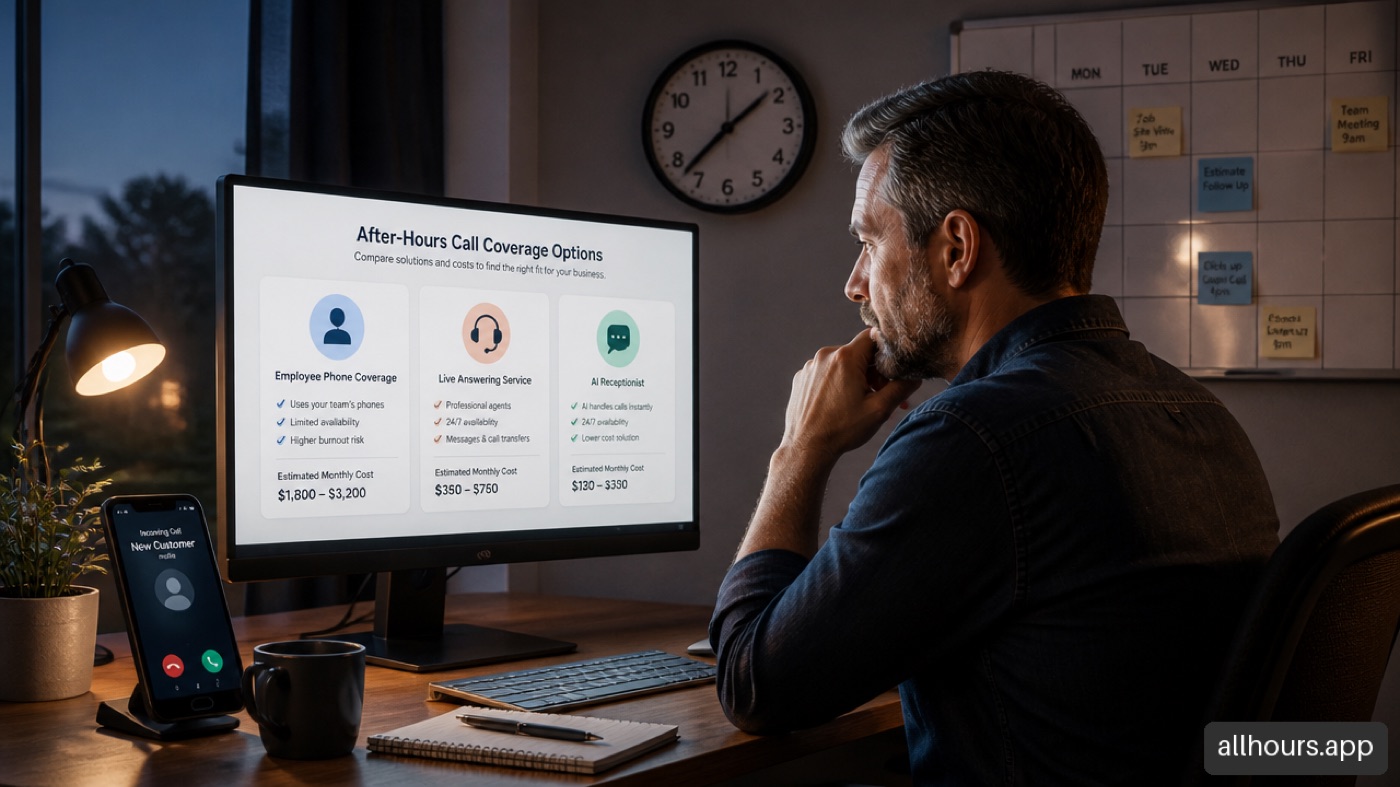
Table Of Contents
- What You Are Actually Paying For
- Three Ways To Buy Coverage
- Comparing Quotes With Real Math
- Scope, Add-Ons, And Hidden Charges
- Matching The Model To Your Call Pattern
- Frequently Asked Questions
- Sources
What You Are Actually Paying For
Separate availability cost from handled-call cost. Availability is what keeps a person, service, or system ready at 9:30 on a Saturday night. Handled-call cost is what you pay when a caller needs intake, scheduling, a transfer, or an escalation.
A plan can look cheap because it quotes only usage. Another looks expensive because it includes a retainer for round-the-clock capacity. Neither is automatically better.
The Three Cost Buckets
| Bucket | What it covers | Why it moves the bill |
|---|---|---|
| Fixed availability | Staffing, retainer, subscription, coverage window | Longer hours, weekends, and 24/7 raise the base commitment |
| Variable handling | Minutes, calls, messages, bookings, transfers | More and longer calls increase usage charges |
| Exception handling | Emergencies, bilingual support, holidays, dispatch, compliance | These need extra labor, rules, or specialist process |
A plumbing company taking 40 after-hours calls a month where only 10 need a human does not need to pay for someone to sit available all night. It needs dependable intake for 40 and a controlled way to reach a person for 10.
Most businesses accidentally buy human availability for every routine question. A caller asking about next-day availability does not need the same coverage model as a caller reporting a burst pipe.
Why Off-Hours Rates Rise
Off-hours coverage is priced above daytime answering because providers must maintain staff when volume is less predictable. ServiceAgent.ai’s pricing comparison notes after-hours premiums may run roughly 1.5 to 2 times daytime rates for evenings, weekends, and holidays.
That does not mean buy 24/7. A dental office with no meaningful calls after 8 PM wastes money on overnight live agents. A restoration contractor loses high-value work without a 2 AM response. Let the coverage window follow the economics of the calls.
Do Not Confuse Coverage With On-Call Pay
Two different expenses get mixed together constantly:
- Call handling coverage pays someone or something to answer, collect information, book, and route.
- On-call compensation pays a technician, clinician, or manager to remain available for escalations.
Buckhead FMV’s guidance on call compensation describes clinician on-call structures such as an hourly availability rate or a rate for a whole coverage period. That is not the same as buying an answering service. Budget them as separate lines, or the answering service gets blamed for a staffing cost it does not control.
Three Ways To Buy Coverage
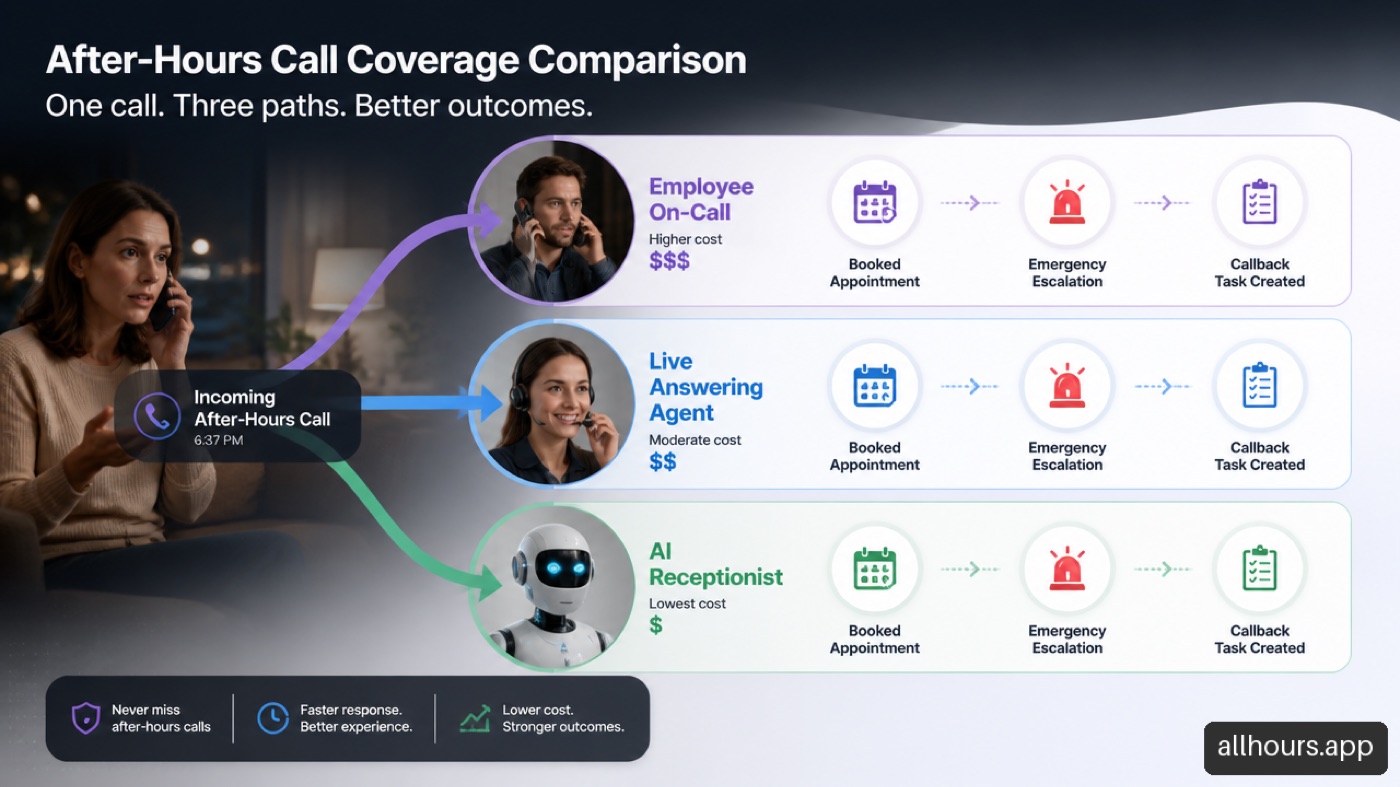
1. An Employee Or On-Call Rotation
In-house coverage gives direct control. Your employee knows your scripts, your service rules, and your customers. It also carries the highest fixed commitment.
The true cost is more than wages: overtime rules, payroll taxes, benefits, scheduling administration, training, supervisor time, turnover, and covering the covering person when they are sick.
| Cost element | What it includes | Where businesses undercount |
|---|---|---|
| Direct labor | On-call pay, overtime, callback time, payroll taxes | Counting only the phone conversation |
| Management time | Schedules, coaching, disputes, coverage swaps | Treating coordination as incidental |
| Turnover risk | Fatigue, morale, hiring and retraining | Keeping the same people on nights too long |
| Quality control | Script updates, call review, documentation | Inconsistent notes between staff |
| Morning follow-up | Returning messages, checking calendars, assigning jobs | Assuming the call was resolved overnight |
That last row deserves attention. If one employee spends an hour each morning sorting voicemails and returning calls, that labor belongs to the after-hours program. It does not disappear because it happens after the phones reopen.
Fair warning: rotating phones among technicians without a script, intake form, or escalation policy is not a coverage strategy. It is an informal handoff. Details get lost and technicians cannot answer while driving or on a roof.
2. An Outsourced Live Answering Service
Trained agents answer under your business name, capture messages, follow scripts, and sometimes transfer or dispatch. This converts staffing burden into a vendor fee, but pricing is hard to compare because providers mix base fees, minutes, call counts, and after-hours surcharges.
SmartCallService’s cost breakdown describes a common structure: a base fee of roughly $30 to $75 plus per-minute charges around $0.75 to $1.50. Treat those as a planning reference, not a market rate.
Staffing model matters as much as volume. Call Force Global’s published pricing lists shared after-hours tiers of $300, $650, and $1,500 per month, with dedicated seats around $12 to $18 per agent hour. Shared agents serve several businesses and cost less; dedicated seats reserve capacity for you and cost considerably more.
The trade-off is instruction quality. If the script says “take a message,” the service answers every call and still produces a callback backlog. Given service areas, urgency criteria, and escalation contacts, it produces something more useful — and the price usually reflects that added operational work.
3. An AI Agent Or Automated Receptionist
AI coverage answers routine calls, gathers structured details, checks availability when connected to the right systems, books, confirms, and escalates on defined rules. Its cost structure is generally lower when volume is steady or routine calls dominate.
Aloware’s after-hours coverage analysis gives published examples where human-focused monthly bundles normalize to roughly $1.95 to $5.00 per included minute, while AI receptionist minute blocks normalize to about $1.38 to $1.98. Provider examples, not a universal rate card — but they show why automated intake gets evaluated for high-volume routine traffic.
An AI agent is a poor fit when its only instruction is to sound friendly. It needs guardrails: service areas, hours, appointment types, technician skills, buffers, booking caps, emergency definitions, and a reliable escalation route. Without them, automation creates the expensive kind of error — an appointment promised in the wrong place, at the wrong time, for work you do not perform.
Comparing Quotes With Real Math
Estimate Demand Before Choosing A Plan
Start with 60 to 90 days of phone records. A short sample misleads — one storm weekend distorts everything.
- Count calls received outside your normal hours.
- Remove obvious spam, wrong numbers, and repeat callbacks.
- Estimate average handle time for real calls.
- Mark how many need a human, a transfer, or emergency dispatch.
- Calculate bookings and revenue from calls that were answered.
Effective cost per answered call = total monthly coverage cost ÷ answered after-hours calls.
A $300 plan answering 60 legitimate calls costs $5 per answered call. If it produces 15 booked jobs, that is $20 per booked job. Whether that is acceptable depends on gross profit, not top-line revenue.
Run The Break-Even
Per-minute plans suit low or uncertain volume. Bundles suit predictable usage. Flat rates suit high volume or a need for guaranteed availability.
| Pricing method | Example math | Best when | Watch for |
|---|---|---|---|
| Per-minute | 100 min × $1.20 = $120, plus base | Low or unpredictable usage | Long calls, rounding, after-hours rates |
| Bundled minutes | $250 for 200 minutes | Fairly stable usage | Unused minutes and costly overages |
| Per-call | 50 calls × stated rate | Calls are short and similar | What counts as a billable or repeat call |
| Flat rate | $600 for defined coverage | High volume or guaranteed capacity | Exclusions, fair-use limits, transfer fees |
Suppose Plan A costs $50 plus $1.25 per minute and Plan B costs $275 including 200 minutes. At 180 minutes both cost $275. Below that, per-minute wins; above it, the bundle wins — before overages. If Plan B charges $1.75 beyond the allowance, a 250-minute month costs $362.50. A buyer comparing only the $275 headline misses that jump entirely.
Model A Normal Month And A Peak Month
A landscaper has quiet winter nights and a surge after spring storms. An HVAC company sees heavy evening demand in a heat wave. Build both scenarios. If the gap between the two invoices would strain the budget, flat or hybrid pricing is safer than pure usage billing.
Use A Revenue Test, Not Just A Cost Test
Coverage can pay for itself even when cost per call looks high. If 40 after-hours calls cost $400 to handle, and 8 become jobs producing $250 gross profit each, that is $2,000 of gross profit against $400 of operating cost.
Change the facts and it inverts. If those 40 calls are mostly price shoppers and out-of-area requests and one job books, the same plan is too expensive. This is why outcome tracking matters more than the invoice: count appointments, qualified leads, emergency dispatches, and rejected calls separately.
Scope, Add-Ons, And Hidden Charges
Billing surprises come from unclear scope, not from the advertised price. Get written answers before signing:
- What is the minimum billable duration per call?
- Do hold time, transfers, voicemail, wrap-up notes, or texts count as billable minutes?
- What is the exact overage rate, and is there a cap?
- Do evening, weekend, and holiday surcharges stack? A holiday on a weekend evening might be one multiplier, the higher of two, or several fees.
- Is onboarding, script creation, integration setup, or number porting billed separately?
- Does appointment booking cost more than message-taking?
- Are bilingual calls, recordings, transcripts, or CRM updates priced as add-ons?
- What happens when an emergency escalation fails to reach the first contact?
- Is there a notice period, minimum term, or early termination fee?
- Can you export call records, recordings, and structured intake data if you leave?
That last question is the one people regret skipping.
Separate Call Types Before You Price Them
| Call type | Handling goal | Cost risk if handled poorly |
|---|---|---|
| New lead | Qualify and book quickly | Lost job to a faster competitor |
| Existing customer | Identify account and route correctly | Frustration or duplicate work |
| Emergency | Escalate on clear rules | Safety risk or delayed response |
| Routine question | Give approved information | Paying human minutes for repetitive answers |
| Spam or wrong number | End politely and fast | Unnecessary billable usage |
Talk time is not customer value. A two-minute urgent repair call is worth far more than ten minutes of spam. If every call consumes paid minutes, weak routing becomes a cost problem.
Matching The Model To Your Call Pattern
| Situation | Usually fits | When to avoid it |
|---|---|---|
| A few low-urgency calls weekly | Voicemail with a disciplined callback process | When leads need immediate booking |
| Variable volume with occasional surges | Per-minute or hybrid coverage | When overage exposure is hard to forecast |
| Frequent routine booking calls | Flat software subscription | When most calls need complex human judgment |
| Complex emergencies or sensitive matters | Live escalation or trained internal rotation | When a generic script cannot safely guide callers |
| Daytime phones often ring out | Overflow coverage | When the real gap is nights and weekends |
Overflow-only is the efficient middle ground when your team answers most calls but gets overwhelmed at peaks. It fails when the office closes at 5 and the valuable calls arrive at 8 — there is no primary team to overflow from.
Call forwarding is only cheaper when someone is genuinely available to answer. Forwarding to a technician who is driving or on a job moves the missed-call risk to another phone. See conditional call forwarding for how to set the destination properly.
Every Model Has A Predictable Failure
| Model | Common failure | Recovery step |
|---|---|---|
| Employee rotation | Missed calls during field work or fatigue | Backup routing, clear on-call schedules, structured intake forms |
| Live answering service | Agents lack current business rules | Update scripts, audit recordings, supply explicit routing rules |
| AI agent | Incorrect booking or poor edge-case handling | Connect live scheduling data, route uncertain calls to a person |
| Hybrid | Confusion about when the handoff occurs | Define escalation triggers and test with real scenarios |
The goal is not perfect automation or perfect staffing. It is a controlled recovery path when something unusual happens.
Frequently Asked Questions
How much does after-hours coverage cost per month?
It varies by hours covered, volume, average call length, staffing model, and features. The meaningful number is the total bill after base fees, included usage, overages, transfers, and holiday charges — built from your own call records rather than a starting price.
Is per-minute or flat monthly cheaper?
Per-minute is often cheaper at low, unpredictable volume. Flat pricing is easier to budget when calls are frequent and routine. Compare at normal volume and peak volume; if peak-month overages blow up the per-minute plan, flat is safer.
What counts as after-hours coverage?
Calls outside your normal schedule — evenings, weekends, holidays, early mornings. That differs from overflow coverage, which handles calls during business hours when staff are busy or already on another line.
Why do nights and weekends cost more?
Staffing those shifts costs more. Check whether premiums apply to all calls, only certain hours, or only time beyond an included allowance — and whether they stack with holiday rates.
Does appointment scheduling cost extra?
It can. Scheduling is included in some software plans but treated as premium with live answering providers. The bigger question is whether the system can book against real availability and update your existing calendar without manual re-entry.
Are AI answering services cheaper than live operators?
Often, especially for high volumes of routine calls. The savings are strongest when the AI can answer common questions, collect complete details, schedule accurately, and confirm. Keep a human escalation route for emergencies and unusual cases regardless.
Is coverage worth it if I only get a few calls a week?
It may be, if even one missed call represents a valuable job or urgent customer. If calls are genuinely low-value and can wait, voicemail plus a strict morning callback process may be enough. The deciding factor is the likely value of the calls, not the raw count.
How do I tell whether coverage is paying for itself?
Track answered calls, qualified leads, bookings, emergency dispatches, and gross profit from work tied to after-hours calls, then compare with the full monthly cost. A cheaper service that produces inaccurate bookings or slow callbacks can cost more than it saves.
Sources
- Aloware — After-Hours Answering Service: What Coverage Really Costs: https://aloware.com/blog/after-hours-answering-service-cost
- SmartCallService — After Hours Answering Service Cost Breakdown: https://smartcallservice.com/blog/after-hours-answering-service-cost-breakdown
- ServiceAgent.ai — After-Hours Answering Service Cost (2026 Pricing): https://serviceagent.ai/blogs/after-hours-answering-service-cost/
- Call Force Global — After-Hours Call Center: 24/7 + Overflow Coverage: https://callforce.global/services/after-hours-call-center/
- Buckhead FMV — Guidance on Setting a Reasonable Rate for After-Hours Practice Call Compensation: https://www.buckheadfmv.com/single-post/guidance-on-setting-a-reasonable-rate-for-after-hours-practice-call-compensation