comparison
AI receptionist vs answering service: what each does with a call
Both stop calls going to voicemail. The difference is whether the call ends with a message someone has to work, or a job already on the schedule.
Both options prevent a call from reaching voicemail. That is where the similarity ends, and where most comparisons stop being useful.
The question worth asking is narrower: does the call end with a message, a handoff, or completed work? An answering service puts a trained remote operator on the line to take notes and follow your routing instructions. An AI receptionist uses speech recognition, your business rules, and connected systems to take an approved action during the call. Choosing well means following one caller from the first ring to the record that lands in your office, not comparing whether the voice is human.
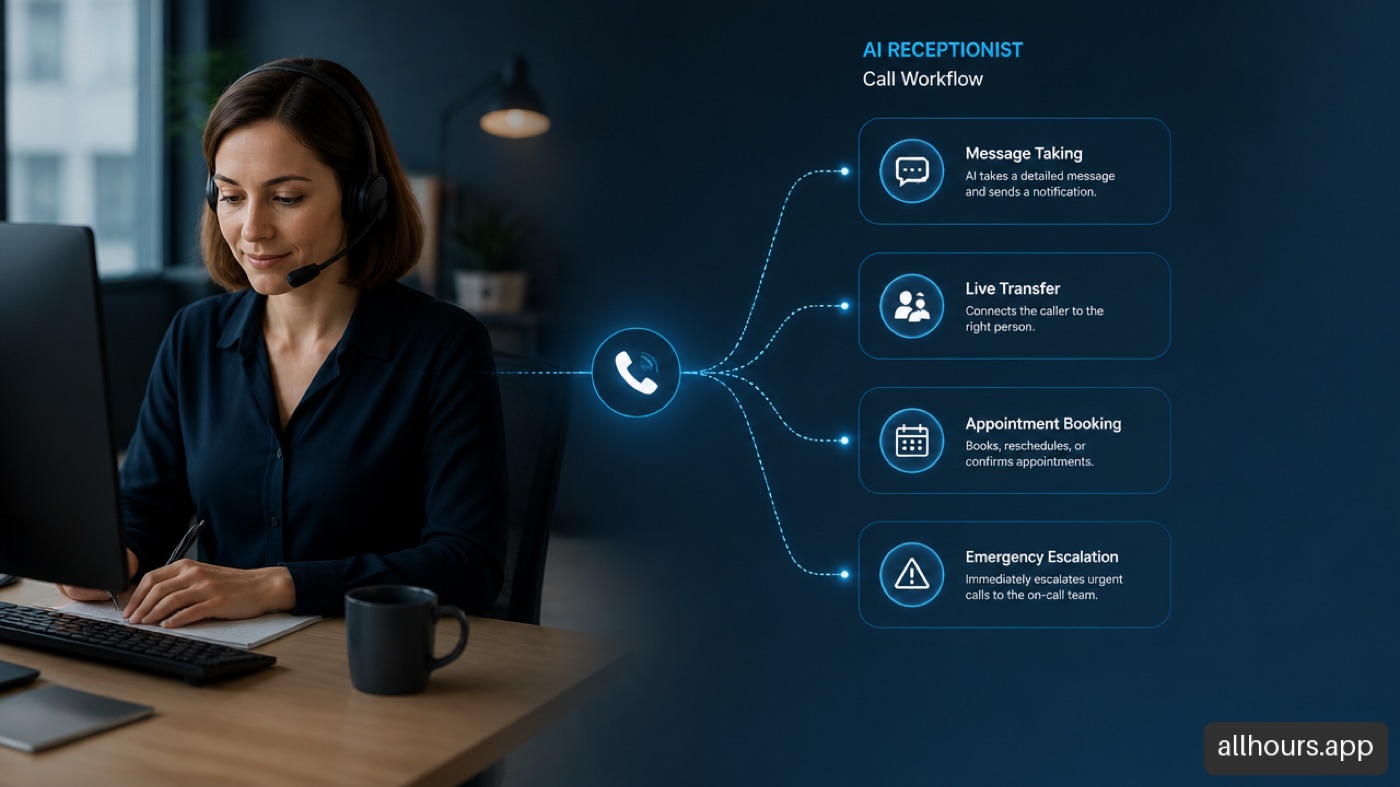
Table Of Contents
- What Happens From Ring To Wrap-Up
- Five Actions Worth Separating
- What Each Costs, And Why The Models Differ
- Emergencies, Angry Callers, And Ambiguity
- Choosing, And The Hybrid Middle Ground
- Frequently Asked Questions
- Sources
What Happens From Ring To Wrap-Up
The Answering Service Call Lifecycle
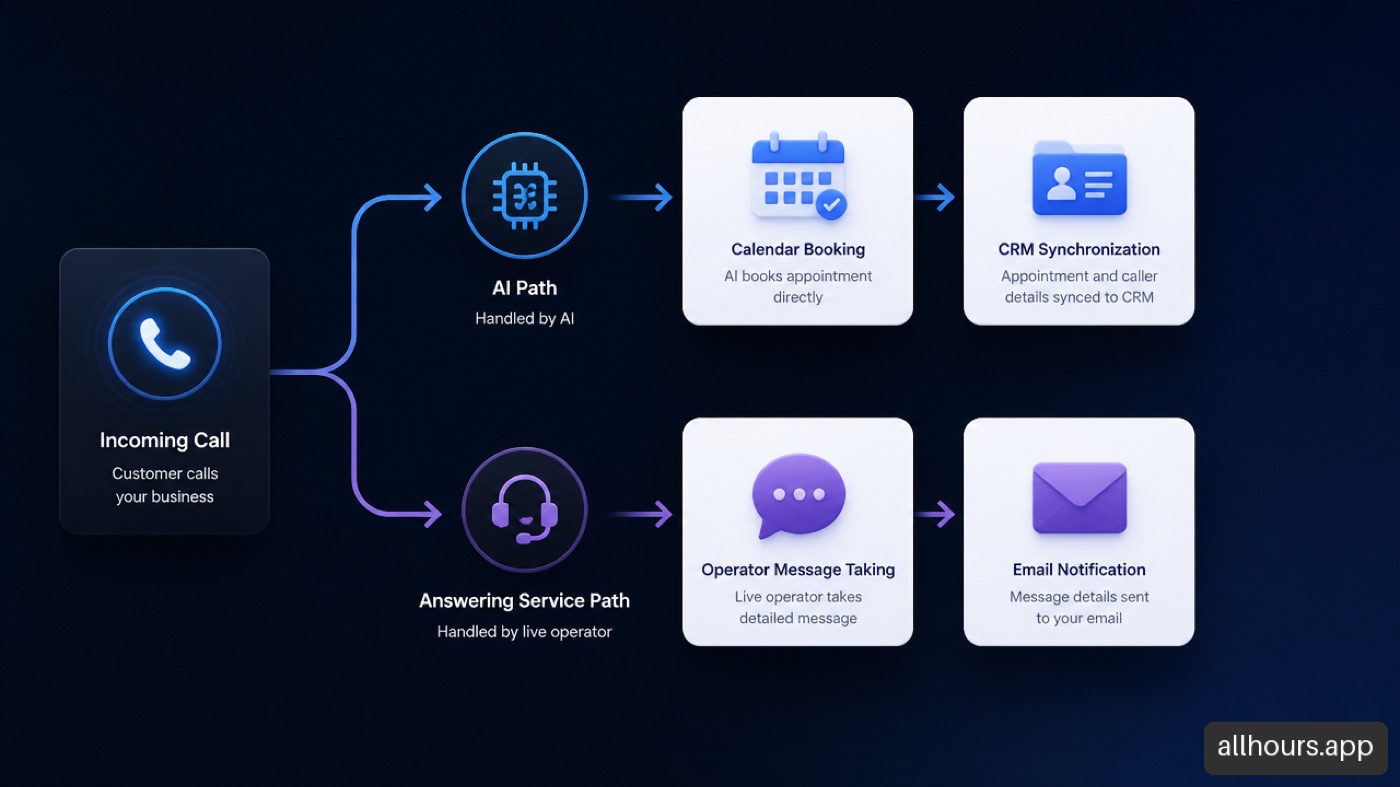
A human service usually opens with a business-specific greeting, then works a script:
- The call is answered. The operator identifies your business and gives the caller a live response.
- The operator identifies the need. Service request, emergency, hours question, or a specific person.
- The operator takes notes. Name, callback number, address, issue description, preferred time, urgency.
- Routing rules are applied. Urgent calls may be transferred or sent to an on-call contact; routine ones become messages.
- The record is delivered. Text, email, app notification, or a CRM entry.
The call usually ends with a promise: someone will call back, review the request, or confirm availability. That is genuinely better than voicemail. It also creates a second task for your office.
Talkroute’s comparison of call handling models draws the same line: answering services typically take messages or transfer, while AI receptionists can qualify, route, and book within the same interaction.
The AI Receptionist Call Lifecycle
The conversational voice is not the interesting part. The workflow behind it is:
- It answers immediately, identifies the business, and states what it can do.
- It identifies intent — estimate, repair, appointment, status update, emergency, or transfer.
- It gathers structured intake, asking the same questions in the same order for a given job type.
- It checks business rules — service area, hours, technician skills, appointment buffers, capacity, protected emergency windows.
- It completes or escalates — books an eligible slot, sends confirmation, transfers the caller, or alerts an on-call person.
- It writes the record — transcript, summary, caller details, and booking into the CRM, calendar, or dispatch system.
This only works when scheduling access is accurate and the rules are properly defined. Without those, automation moves the error earlier in the process rather than removing it.
Where They Structurally Differ
| Capability | AI receptionist | Answering service |
|---|---|---|
| Availability awareness | Reads live calendar and capacity | Static instruction sheet or shift notes |
| Primary call outcome | Confirmed booking or qualified intake | Written message or transfer attempt |
| Where details land | CRM, FSM software, or scheduling database | Email, SMS, or provider portal |
| Concurrency | Many simultaneous calls, no hold queue | Limited by the live operator pool |
| Consistency | Identical intake every time | Varies by operator and shift |
| Judgment and empathy | Bounded by written rules | Adaptive, human, real-time |
The last two rows are the honest trade. Consistency and judgment are not the same virtue, and different calls need different ones.
Five Actions Worth Separating
The most useful distinction is not human versus AI. It is answering, triaging, transferring, message-taking, and completing. These are five separate jobs that marketing language tends to blur.
| Action | What it means | Typical outcome |
|---|---|---|
| Answering | Responding before voicemail or abandonment | The caller reaches a voice |
| Triaging | Determining intent, urgency, and fit | The call is categorized |
| Transferring | Connecting the caller to a person | A live handoff or urgent alert |
| Message-taking | Recording information for later | Staff must review and follow up |
| Completing | Finishing an approved task on the call | An appointment or service request exists |
Zenoti’s explanation of AI receptionist capabilities notes that an AI receptionist can complete booking and other routine actions during the call, while an answering service mainly routes and takes messages.
That word “booking” deserves scrutiny. Booking is not collecting a preferred time. It means checking valid openings, selecting one, reserving it, and writing it to the system of record. An appointment request is not an appointment.
What Each Captures Reliably
A useful intake usually includes caller name and verified callback number, service address, new or existing customer status, requested service and problem description, urgency indicators, preferred window, service-area fit, and communication consent.
Human operators capture nuance in free-form notes — hesitation, frustration, the detail a caller volunteers sideways. AI collects structured fields consistently, which makes records searchable, sortable, and routable. The trade-off is real: an AI only collects what its conversation design thought to ask about.
Clara’s overview of structured AI intake describes that consistency as the main operational advantage — useful when every plumbing inquiry must include an address, leak severity, and access details before dispatch can decide anything.
What Each Costs, And Why The Models Differ
Per-Minute Versus Flat Rate
Answering services generally bill per minute or per agent-second, with a base plan that includes an allowance and overage rates beyond it. Because operators ask clarifying questions, look up scripts, and wait during transfers, billable minutes accumulate faster than the conversation seems to warrant.
Answering service:  base + ((agent minutes − included) × overage) + transfer fees
AI receptionist:    fixed monthly tier + optional add-ons
That difference creates a subtle conflict in the per-minute model: every extra second of thorough intake increases the invoice. A detailed six-minute qualification call is operationally good and financially punished. With flat pricing, longer conversations do not trigger penalty rates, so intake depth stops being a budget decision.
Concurrency Is A Cost Question Too
Call volume is not uniform. Storms, campaigns, and heat waves produce a dozen calls in the same minute.
- Answering services share an operator pool across many client accounts. During regional weather events or the morning rush, hold times rise and calls drop.
- AI receptionists answer concurrent calls with identical consistency, whether one caller rings or thirty.
Overloaded call centers produce exactly the hold-and-hang-up pattern described in why people hang up before the beep. Paying for coverage that queues callers can still lose the job.
For the full cost comparison including employee rotations, see what after-hours call coverage costs.
Emergencies, Angry Callers, And Ambiguity
Two Escalation Paths
When a pipe bursts or a furnace fails in freezing weather, the escalation mechanics differ:
AI dispatch: the system recognizes defined emergency signals during natural conversation, executes conditional logic — calling the on-call technician, sending urgent notifications, relaying structured notes — and escalates to a secondary contact if the first does not acknowledge within a set window.
Human operator dispatch: the agent notes the complaint, dials the emergency transfer number while holding the caller, and if nobody answers, leaves a message or works down a paper call sheet.
Rules-based escalation removes operator delay and is consistent at 3 AM. It is also only as good as the rules, which is the whole argument in after-hours emergency calls without missed escalations.
Where Human Services Genuinely Win
Being straight about this matters more than the pitch:
- Irate existing customers. Someone furious about a botched job or a billing dispute wants human empathy and active listening. A script can escalate that frustration.
- Ambiguous requests. Heavy background noise, industry slang, half-formed thoughts — humans reason across all of it to find the intent.
- Complex negotiation. Open-ended problem solving outside written rules belongs to trained people.
- Distress. “My mother is panicking and water is coming through the ceiling” needs reassurance before it needs a calendar slot.
Vida’s comparison of human and AI handling identifies the same split: humans lead on empathy-driven edge cases, AI on consistency and workflow integration.
Compliance Applies To Both
Recording consent rules apply regardless of who or what answers. In two-party consent jurisdictions, an automated disclosure must play before details are collected. Verify the rules for every state you operate in, keep role-based access to recordings and transcripts, set retention limits, and have a process for correcting inaccurate customer records.
One rule specific to automation: if the system says it can book an appointment, the integration must actually create or hold that appointment. Anything else is a promise the business has to undo.
Choosing, And The Hybrid Middle Ground
A Practical Decision Table
| Business need | Better starting point | Reason |
|---|---|---|
| Emotional, sensitive, or ambiguous calls | Answering service | Human judgment and tone adapt in real time |
| Routine bookings with live scheduling data | AI receptionist | It can qualify, check availability, book, and confirm on the call |
| Overflow during busy office hours | Either, often hybrid | Depends on whether overflow needs booking or just capture |
| After-hours emergency coverage | Hybrid | Either can triage; the escalation rules are what matter |
| Fast growth in repetitive inbound calls | AI receptionist | Consistent intake and concurrency relieve the bottleneck |
| No reliable calendar or CRM integration | Answering service, or a limited AI pilot | Direct booking is risky when the underlying data is incomplete |
That last row is the one businesses skip. Automated booking against unreliable availability is worse than message-taking, because now you are undoing appointments instead of returning calls.
The Hybrid Architecture
Most organizations past a certain volume do not choose. They layer:
- Tier 1 (automated): answers every call instantly, handles FAQs, checks availability, collects structured intake, books standard work.
- Tier 2 (human): receives explicit requests for a person, severe frustration, complex estimates, and anything outside the written rules, via warm transfer with the context already collected.
The quality of the handoff is what makes this feel coordinated rather than evasive. A transfer where the caller repeats their address is a hybrid model failing.
Measure Outcomes, Not Answer Rate
A system can answer every call and still fail. Track before and after:
- Answered call rate — how many inbound calls got a response rather than voicemail
- Time to answer — how long before a useful interaction begins
- Call completion rate — how often calls end in a booking, transfer, qualified lead, or resolved question
- Qualified booking rate — how many appointments actually meet service area, job type, and scheduling rules
- Escalation accuracy — do real emergencies reach people quickly, without flooding staff with routine transfers
- Repeat contact rate — how often callers must call again because the first interaction failed
- Record quality — are names, addresses, and job details complete enough to dispatch from
Review a sample of recordings or transcripts regularly where permitted. Then weigh the result against the cost of missed calls rather than against the monthly invoice alone. A cheap service producing incomplete messages can create more office work than it saves.
Build The Playbook Before Turning Calls On
Both models depend on the same five documents, though a human operator can interpret them more flexibly:
- Services, service areas, and explicitly excluded requests
- A structured intake form for each major call type
- Booking rules, buffers, capacity limits, and technician qualifications
- Emergency and complaint escalation instructions, with primary and backup contacts
- Approved answers for common pricing, hours, and availability questions
Frequently Asked Questions
What is the primary difference between an AI receptionist and an answering service?
An AI receptionist uses conversational software to answer, check live calendars, book appointments, and sync data into your systems. A traditional answering service uses human operators to take messages, answer basic questions, and relay summaries by email or text.
Can an answering service book appointments?
Some can. The real question is whether the operator can see accurate availability and has permission to reserve the slot. If your booking rules are complex, test specifically for double-booking, technician mismatch, and service-area errors before relying on it.
Can an AI receptionist transfer to a live person?
Yes. A properly configured one transfers based on intent, urgency, explicit request, or repeated misunderstanding — and passes the caller’s details so the person receiving the transfer does not start from zero.
Which is better for after-hours calls?
It depends on the call mix. AI provides immediate routine coverage, booking, and structured intake outside office hours. A human service may be better for emotionally difficult or unusual calls. For emergencies, either needs written escalation rules and reachable contacts.
Which handles emergencies better?
Neither should be trusted without a tested emergency workflow. Humans apply judgment when facts are unclear; AI applies consistent rules and alerts contacts quickly. A hybrid is often right when you need both fast triage and human decision-making.
Which is more cost-effective for a small business?
AI receptionists are usually more predictable at moderate to high volume because they charge flat monthly rates rather than per minute. At low, unpredictable volume, per-minute human coverage can be cheaper. Compare both at your normal month and your busiest month.
Can I use both together?
Yes, and many businesses do. AI answers first, handles routine bookings and overflow; humans take emergencies, complaints, complex estimates, and anyone who asks for a person.
How do I know whether it is working?
Measure answer rate, time to answer, completed bookings, qualified leads, transfer success, repeat calls, and record accuracy. A high answer rate means little if callers still have to call back for basic answers.
Sources
- Zenoti — AI Receptionist vs. Call Answering Service: https://www.zenoti.com/thecheckin/ai-receptionist-vs-call-bot
- Talkroute — AI Receptionist vs Answering Service: What’s the Difference? https://talkroute.com/ai-receptionist-vs-answering-service-whats-the-difference/
- Clara — AI Receptionist vs Live Answering Service: An Honest Comparison: https://heyitsclara.com/us/blog/ai-receptionist-vs-live-answering-service/
- Vida — AI Receptionist vs. Answering Service: Which Is Better? https://vida.io/blog/ai-receptionist-vs-answering-service